Engineering Reliability: Inside the Work of a Solar Inverter Manufacturer
The global shift to renewable energy relies on a humble but essential device – the solar inverter.
It is the heart of every photovoltaic system, converting direct current (DC) from the panels into alternating current (AC) for use in the grid or batteries.
Behind this shift lies a highly specialized industrial discipline: solar inverter manufacturers , where every watt of power is defined by precision, stability, and testing integrity.
As renewable energy capacity expands, so does the complexity of inverter production. Each market demands not only high efficiency but also strict adherence to safety and communication standards.
As a result, manufacturers must balance three objectives—performance, reliability, and adaptability—across vastly different project types.
Manufacturing Logic: How Quality is Designed, Not Tested
A true solar inverter manufacturer will build quality into every step of production rather than relying on post-assembly testing.
This “reliability by design” approach involves three key pillars:
Precision Circuit Integration
Automated SMT and AOI inspection ensure accurate component placement and minimize human error.Thermal Management System
High-density heat sink and intelligent fan maintain stable performance in outdoor conditions of 50°C+.Dynamic simulation test
Each inverter undergoes load fluctuation and short-circuit simulation to verify actual durability.
Instead of lot-based sampling, advanced factories now use 100% traceable verification , linking each unit’s serial number to digital production data.
This transparency enables predictable performance across thousands of installations.
Comparing manufacturing levels
| category | Entry-level manufacturers | Advanced Manufacturers |
|---|---|---|
| assembly | Semi-manual, limited automation | Fully automatic SMT and wave soldering production line |
| Test Method | Random batch testing | Continuous digital verification |
| efficiency | 94–96% | 98.5–99% conversion efficiency |
| Thermal design | Passive radiator only | Intelligent airflow and liquid cooling |
| Firmware Update | Manual | Remote OTA upgrade support |
| Certification | Basic local compliance | CE, UL, IEC, ISO 9001, ISO 14001 |
This distinction highlights a key fact: advanced manufacturing processes not only improve efficiency but also reduce field failure rates and total cost of ownership (TCO) over the inverter's 10- to 15-year lifespan. 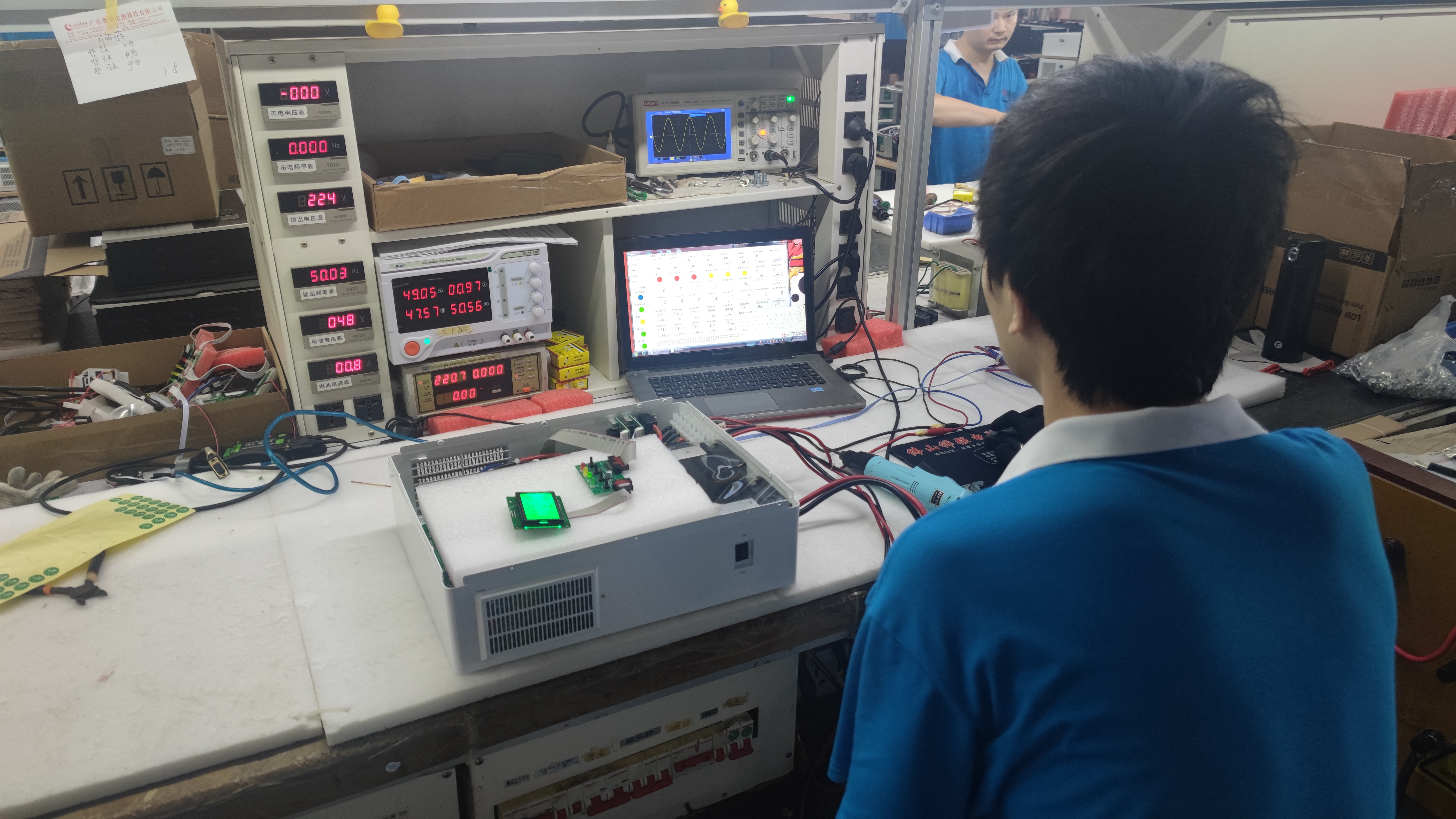
Inside the factory: process flow from PCB to power output
Component Sourcing – All electronic parts are audited by suppliers to ensure consistent quality and traceability.
SMT Line Assembly – Automated soldering ensures precise placement of MOSFETs, IGBTs and control boards.
In-Circuit Test (ICT) – Verifies that each board operates within microsecond response tolerances.
Burn-in test (72 hours) – Equipment operates at full load at elevated temperatures to identify early component failures.
Calibration and Firmware Loading – Each unit receives a unique software ID for future OTA updates.
Final Packaging - Products are vacuum sealed and equipped with humidity indicators to ensure safety for global shipping.
These steps ensure that the inverter's rated efficiency, power factor, and harmonic distortion (THD) meet global standards and actual site requirements.
Technological innovation and product differentiation
Modern manufacturers focus not only on conversion efficiency, but also on intelligence, connectivity and energy management.
Some recent developments include:
AI-based MPPT tracking can increase yield by up to 3% under shading conditions.
Smart grid compatibility for frequency regulation and reactive power support.
Integrated communication module, supporting Modbus, CAN, and Wi-Fi.
Hybrid compatibility , allowing seamless PV+battery+generator coordination.
Modular architecture simplifies maintenance and expansion of multi-megawatt projects.
These features transform inverters from passive devices into active energy managers , aligning with the broader evolution of digital power systems.
Applications across energy scales
Solar inverters are suitable for a variety of installation environments, each with different engineering requirements:
Residential Systems: Prioritize quiet operation, compact design, and safety.
Commercial buildings: Focus on grid stability, monitoring, and power factor correction.
Industrial parks: Require high surge tolerance and scalable hybrid functionality.
Utility-scale projects: Require advanced cooling, remote monitoring, and redundancy.
By maintaining multiple product lines (single-phase, three-phase, and hybrid), the manufacturer supports integrators at all project levels.
How to Evaluate a Reliable Solar Inverter Manufacturer
For EPC contractors, distributors, and energy developers, choosing the right manufacturer can determine the long-term success of a project.
Here are practical and verifiable indicators of a reliable partner:
| Evaluation factors | Why it matters | What needs to be verified |
|---|---|---|
| Certification Portfolio | Achieve global market access | CE, UL, IEC, ISO documents |
| Process transparency | Ensure traceable quality | Production log or test report |
| Thermal design verification | Extend the service life of the inverter | High temperature aging data |
| Firmware ecosystem | Reduce downtime | OTA update, hybrid mode |
| Support infrastructure | Enhanced reliability | Regional Service Partners |
Other indicators include consistent parts sourcing, integration of ERP/QMS systems, and in-house R&D capabilities—all signals of a mature manufacturing ecosystem.
Frequently Asked Questions
Question 1: How long should manufacturers test inverters before shipping?
Leading factories conduct aging tests for at least 72 hours under full load and thermal stress conditions.
Question 2: What efficiency level can high-end solar inverters achieve?
Top-of-the-line models typically achieve 98.5–99% conversion efficiency with less than 3% harmonic distortion.
Q3: How does firmware affect inverter performance?
The firmware determines MPPT tracking, grid synchronization, and protection response—it is the “digital engine” of the inverter.
Question 4: What is the standard warranty period for reliable manufacturers?
Typically 5 to 10 years, extendable to 15 years under a maintenance agreement.
Q5: How do manufacturers ensure global compatibility?
Ensure global plug-and-play deployment with modular firmware and compliance with multiple regional certifications.
Manufacturing a renewable energy future
The evolution of solar inverter manufacturers reflects the broader energy transition: precision manufacturing, transparent data and global compliance now determine competitiveness more than price alone.
At Thlinksolar , these principles are reflected in every stage of design and assembly – engineering reliability, scalability and sustainability for a global energy future.
To learn more about our inverter production capabilities or explore OEM collaborations, please visit the Thlinksolar homepage or contact us via our contact page .