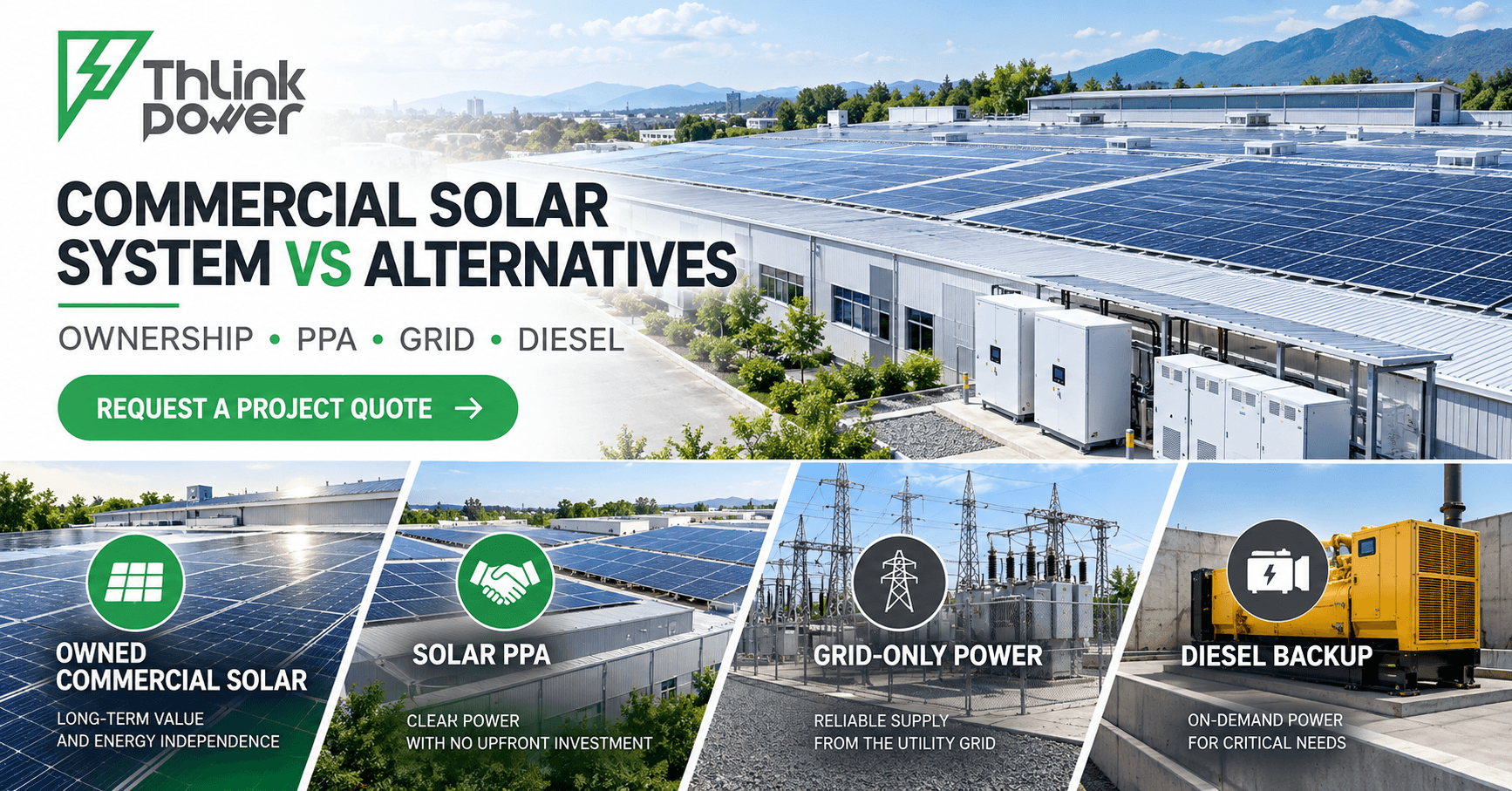
Short answer: There is no universally “best” power option for a factory, warehouse, hotel, mine, cold store, or commercial campus. An owned commercial solar system usually offers the strongest control over equipment and long-term savings. A solar power-purchase agreement (PPA) can preserve capital and transfer part of the operating risk. Grid-only supply is operationally simple where service is reliable and tariffs are predictable. Diesel generation remains valuable for emergency power, remote sites, and short-duration peaks, yet its fuel exposure and maintenance burden make it a weak default energy source. Solar plus storage and a generator can be the most resilient arrangement, provided the control philosophy is engineered before equipment is ordered.
The right decision therefore starts with the buyer’s load, tariff, outage cost, site constraints, financing rules, and required service level—not with a module price per watt. What follows is the working sheet I would want beside me in a bid meeting: one boundary for ownership, PPA, grid, diesel, and hybrid supply. The RFQ section is deliberately specific. Its purpose is simple—make five bidders price one job, instead of five slightly different jobs.
Send Your Load Profile for a Project Review
1. First define the decision you are actually making
A surprising number of energy procurements fail before the first quotation arrives.The buyer asks, “What is the price of a 500 kW solar system?” while the real question is much broader: “How can this site buy reliable electricity for the next fifteen years, within our capital limit, without creating unacceptable operating or contract risk?” Those are not equivalent questions.
Begin with a written decision statement. Name the site and the period being modeled. Then write down the critical load, tolerated interruption, currency, tax basis, and the buyer’s appetite for owning equipment. Put a box around the scope: energy only, or energy plus demand reduction, backup, power quality, carbon data, and expansion? A cold-storage owner that loses product after a two-hour outage is buying a different service from a warehouse that can stop conveyors until the grid returns.
Next, set one common system boundary. If an owned solar quotation includes switchgear, civil works, monitoring, commissioning, and ten years of maintenance, the PPA and diesel cases must include equivalent functions. If grid electricity is treated as “no capital cost” but a new transformer and utility deposit are required, those costs belong in the grid case. If diesel is modeled only at the generator purchase price and fuel, overhaul, storage, spill control, and operator time are omitted, the result is biased before any calculation begins.
The output of this step should fit on one page. It becomes the commercial brief used by engineering, finance, operations, and management. Without it, each department optimizes a different answer.
2.Executive comparison: five supply strategies
| Option | Upfront capital | Cost exposure | Operational control | Resilience | Best fit |
|---|---|---|---|---|---|
| Owned solar | High | Low fuel exposure; asset and O&M risk retained | High | Low without storage/backup | Creditworthy owner with usable roof/land and long site tenure |
| Solar PPA or lease | Low to moderate | Contract price, escalator, take-or-pay and termination exposure | Medium to low | Low unless contracted with storage | Capital-constrained buyer with stable occupancy and bankable offtake |
| Grid only | Usually low, except new connection works | Tariff, demand charge and outage exposure | Low | Depends on utility | Reliable grid, limited site rights, short occupancy |
| Diesel generation | Moderate | Fuel price, logistics, maintenance and overhaul exposure | High | High if maintained and fuel is available | Emergency duty, remote loads, construction, limited runtime |
| Solar + storage + grid/generator | Highest | Control, cycling, replacement and integration exposure | High | Potentially high | Outage-sensitive or weak-grid sites with defined critical loads |
This table is a screening tool, not a verdict. A PPA can be more expensive than ownership but still create more value if capital is scarce.Diesel can have the highest energy cost but remain indispensable because it starts at night when solar cannot. Storage may improve resilience but lose money if it is sized from a daily-energy estimate rather than the actual outage sequence and peak-demand window.
Use four lenses together: economics, service, risk, and strategic fit. A solution that wins only on an optimistic payback calculation should not pass the investment committee.
3. Start with interval load data, not a monthly bill
A monthly bill answers “how much?” It rarely answers “when?”, and that missing word drives self-consumption, inverter loading, battery dispatch, and generator fuel use. Request a continuous year of demand readings at 15- or 30-minute resolution. A seasonal processor should bring two years if it has them; one unusual harvest can otherwise distort the design. Include active energy, maximum demand, billed power factor, tariff period, and recorded outages.
Do a data-cleaning pass before anyone presses “simulate.” Missing half-hours, repeated timestamps, clock changes, a replaced meter, a holiday shutdown, or one frantic production week can bend the result. Flag each of those events. Keep planned expansion on its own line too. If a new machine runs on the afternoon shift, add it to those hours—not as a lazy percentage pasted across all 8,760 hours.
Then split loads into three classes. “Must run” loads protect safety, product, data, or a continuous process. “Should run” loads preserve useful production but can be shed briefly.“Can wait” loads may be deferred during an outage or peak tariff window. This classification often reduces the size of the backup system dramatically. A 2 MW factory may need only 350 kW of critical backup, while the full rooftop array can still serve daytime energy savings.
For sites without interval metering, temporary data loggers can establish a representative profile. Record feeder-level demand where possible. A single main-meter trace cannot reveal whether the refrigeration plant, air compressors, pumps, or EV chargers create the peak. That matters because a battery or control change should target the cause, not merely the bill total.
4. Decode the electricity tariff before calculating savings
A commercial bill may contain energy charges, time-of-use periods, demand charges, reactive-power penalties, fixed service fees, taxes, fuel adjustments, capacity charges, and export credits. Solar does not reduce all of these in the same proportion. A rooftop array may cut midday kilowatt-hours but barely touch the monthly peak if the peak occurs after sunset. It may also export surplus at a price far below the retail tariff.
Build a tariff engine that applies each rule to interval data. Preserve the original utility bill as a baseline check: when the model is fed the historical load, its monthly result should reconcile reasonably with the actual invoice. If it does not, the savings result is not yet ready for management.
Ask the utility or local consultant about interconnection limits, reverse-power protection, export compensation, transformer capacity, protection studies, meter requirements, and approval lead time.A zero-export requirement may call for a plant controller and fast metering. A weak feeder may restrict inverter capacity. Some facilities also face a contract-demand ratchet, in which one high peak affects charges for several later months. These rules can change the optimal DC size and battery dispatch.
When comparing a PPA price with the grid tariff, compare like with like. A PPA usually prices generated energy, not every item on the bill. Fixed charges and residual demand charges remain. State the percentage of solar energy expected to be consumed on site and show the consequence of production shutdowns. That one assumption can determine whether a project is attractive.

5. Owned solar: where it wins and where it can disappoint
Direct ownership gives the host control over component selection, operating policy, data, warranties, and future modifications. After debt service or the investment recovery period, the owner continues to receive energy from the asset. Ownership also allows the buyer to specify the exact module, inverter, mounting, monitoring, and spare-parts strategy instead of accepting an investor’s preferred bill of materials.
The trade-off is responsibility. The owner carries construction risk unless it is contractually transferred, and later carries asset-performance risk, insurance, maintenance, cleaning, cybersecurity, warranty administration, and replacement planning.The financial model should therefore include realistic inverter service, monitoring subscriptions, vegetation or roof access, module cleaning where justified, insurance, inspection, and a contingency reserve. An unrealistically low O&M line makes ownership look better on paper without making the plant run better.
Ownership fits buyers with stable long-term occupancy, an acceptable cost of capital, and an internal team able to govern the asset. It can also work when an EPC delivers a turnkey plant and an experienced service provider operates it. The procurement documents must still define acceptance tests, documentation, response times, exclusions, and handover training.
Watch for the roof-life mismatch. A roof due for replacement in year five is a poor host for equipment expected to stay for decades; somebody will pay to lift and reinstall it. Check the remaining structural margin and decide, in writing, who owns waterproofing. Also walk the fire paths, note the corrosion category, and mark future rooftop equipment. A layout that blocks drains or maintenance routes is cheap only on the quotation.
6. Solar PPA or lease: less cash on day one, more contract to read
Under the familiar PPA arrangement, the panels sit at the customer’s site but belong to a third-party project owner. That owner normally operates the plant; the host pays for metered solar electricity over a long contract. The U.S. Environmental Protection Agency’s summary is useful here: it explains how the structure can remove the host’s initial capital payment and place much of the design, permitting, performance, and operating work with the provider.Commercial practice is local, though. Tax treatment and contract rights in one country cannot be copied into another. See the EPA overview of solar PPAs.
A PPA can be sensible when the host wants predictable energy pricing but prefers to invest capital in production equipment. It may also align incentives: the provider earns revenue only when the plant generates billable energy. However, the buyer is exchanging asset ownership for a long-term contract. Read that contract as closely as the inverter schedule. In this deal, paper can cause as much trouble as hardware.
Start with the energy price, its escalator, the term, and the currency used for indexation. Then follow the awkward cases: minimum purchase, deemed energy, curtailment, roof access, insurance, tax, force majeure, a change in law, and early exit. How does the site look at the end of the term? The EPA’s U.S. examples describe long contracts and possible annual escalators. Treat them as a window into that market, not a template for an overseas agreement.
Model three uncomfortable scenarios. What happens if the factory closes a production line and uses less daytime energy? What happens if the roof must be replaced? What happens if the site is sold? A good contract contains workable assignment, relocation, removal, and buyout mechanisms. A low first-year PPA price is not a complete comparison if the escalator compounds above the expected grid tariff or the termination formula is punitive.
7.Grid-only supply: the baseline must include reliability
The grid is often the simplest alternative. There is no rooftop construction, no new generation asset to maintain, and no energy-management control sequence. Where tariffs are competitive, outages are rare, and the site lease is short, grid-only supply can remain the rational baseline.
But “do nothing” is not free of risk. Model tariff escalation, demand-charge exposure, connection upgrades, grid availability, voltage quality, and production losses. Obtain outage logs from both the utility and the plant. A utility reliability average may conceal the performance of the specific feeder serving the facility. Interview operations staff: brief voltage dips that never appear as long outages can still trip drives or controls.
Quantify outage cost carefully. Talk to the shift supervisor and finance team: was material spoiled, did restart create scrap, did a late shipment trigger overtime or a penalty, and was the line cleaned before production returned? The missed kilowatt-hours multiplied by tariff will not capture any of that. For a continuous furnace, cold chain, or process line, the economic damage can be many times the energy value. For a flexible warehouse, it may be modest.
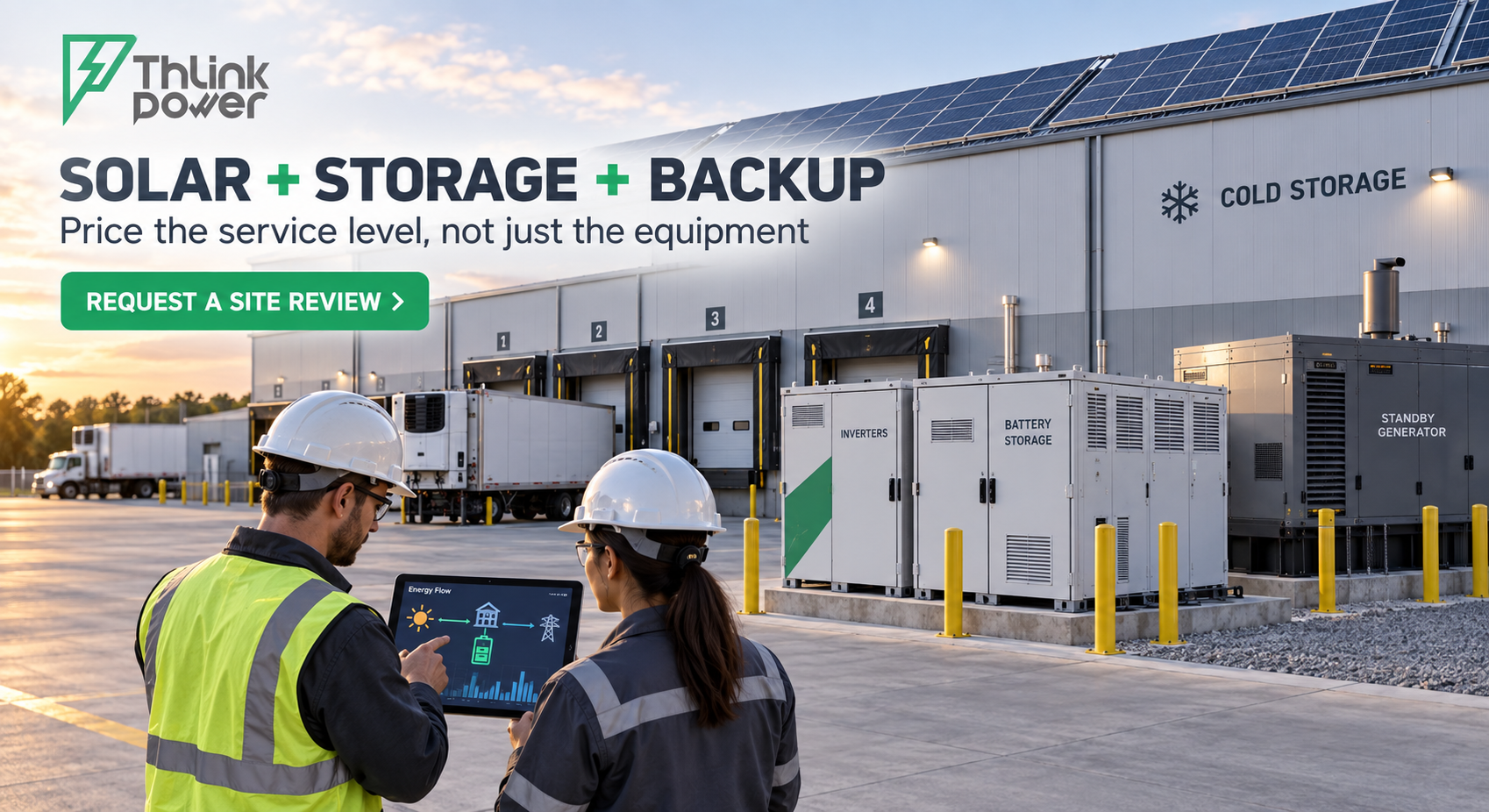
Grid-only also remains part of most solar projects. When the utility disappears, an ordinary on-grid PV plant goes quiet with it. Keeping part of the factory alive calls for an approved island, a grid-forming source, protection, and a transfer sequence designed as one system. Daylight does not change that safety rule. This catches buyers out, so put every required operating mode in writing.
8.Diesel generation: value it as capacity and resilience
A diesel generator is dispatchable, familiar, and relatively compact. It can start after sunset, carry motor loads, and support a remote site where no utility connection exists. For emergency duty, it may be the least-cost method of providing firm capacity. The mistake is treating diesel as an inexpensive source of continuous energy because the initial equipment cost is visible and the lifetime fuel cost is not.
Build the diesel case from delivered fuel price, not a national headline price. Add transport, storage losses, fuel testing, theft controls, lubricants, filters, operator labor, routine exercise, loading tests, emissions compliance, and overhaul. Fuel consumption depends on load. A large generator running lightly can be inefficient and may suffer from poor operating conditions. Obtain the manufacturer’s consumption curve at several load points rather than using one liters-per-hour figure.
Separate standby and prime-power duty. With a standby set that may run only a few hours a year, I care first about one question: will it start when asked? Transfer time, maintenance readiness, and fuel on site follow close behind. Prime-power duty shifts the emphasis toward energy cost, loading, redundancy, service access, and overhaul. A remote critical facility may justify N+1 sets, although it still need not keep every load alive.
Solar can reduce generator runtime and fuel consumption at remote sites, while a battery can absorb solar variation and prevent inefficient starts.Yet generator minimum-loading rules, battery state of charge, inverter overload capability, motor-starting current, and black-start sequence must be coordinated. Hybridization is a controls project, not merely a collection of hardware.
9. Solar plus storage: buy an operating outcome
A battery can perform several jobs: shift solar into evening hours, reduce peak demand, support critical loads during an outage, smooth generator loading, or reduce export. These jobs require different power, energy, control, and cycling characteristics. Asking only for “a 500 kWh battery” is therefore incomplete.
Define the event the battery must survive. A backup brief starts with critical kW and motor-start current. Add power factor, tolerated interruption, outage length, daylight conditions, and the state-of-charge reserve that operations refuses to spend. Peak shaving needs a different brief: the expensive tariff window, a demand ceiling, forecast error, and likely cycles. Solar shifting is different again; simulate the year interval by interval and count conversion loss plus usable depth of discharge.
The control narrative should explain normal grid-connected operation, zero-export control, high-tariff dispatch, outage detection, island formation, load shedding, generator start, generator synchronization where applicable, battery recharge priority, and return to grid. Each transition needs a test. If equipment from several vendors is used, name the party responsible for system-level integration and remote troubleshooting.
THLink Power’s referenced low-voltage storage material includes 51.2 V stackable LiFePO4 options with CAN, RS485, and RS232 communications. Exact usable energy, current limit, protection functions, compatible inverter firmware, cycle conditions, warranty, and certification must be confirmed for the selected model and project country. A buyer should never infer a complete bank rating from a family brochure alone.
10. A fair total-cost model
Payback is useful but incomplete. Procurement teams should calculate net present cost or levelized delivered-energy cost over a defined analysis period, then show payback as a secondary metric. Use the same currency date, inflation basis, tax treatment, financing boundary, and residual-value rule for every option.
For ownership, begin with the installed asset: engineering, permits, equipment, freight, duty, construction, interconnection, and commissioning. On a second line, carry finance, maintenance, insurance, cleaning, monitoring, replacements, degradation, and curtailment. End the row with removal cost or residual value. Do not credit an incentive until eligibility and payment timing have been checked. A PPA row contains purchased energy, escalation, minimum charges, the utility bill that remains, site obligations, and the exit payment. Diesel needs its entire fuel-and-service chain. Grid needs connection plus tariff. A hybrid needs controls and integration as well as replacement and generator support.
A practical present-value equation is:
Net present cost = initial cost + Σ[(annual operating cost + replacement cost − incentives − residual benefits) / (1 + discount rate)year]
The correct discount rate is a finance decision, not a solar-sales assumption. Run sensitivities for tariff escalation, fuel escalation, exchange rate, production degradation, curtailment, downtime, financing rate, and battery replacement. Show the break-even values: at what grid tariff, diesel runtime, PPA escalator, or outage cost does the preferred option change?
11. Worked example from a fictional food processor
Picture a fictional food processor. Last year its meter recorded 4,800 MWh, with a sharpest half-hour of 1,150 kW. Day shift, from 08:00 to 17:00, accounted for 62% of that energy. Once walkways and edge setbacks were drawn, the roof still held about 1 MWp. Refrigeration, controls, and essential pumps formed a 320 kW “do not lose” board. The feeder had a handful of brief trips and one longer failure. These figures exist only to show the method. They are neither a THLink quotation nor a forecast for any country.
The team opens four model tabs. Tab one is grid only. Tab two owns the 1 MWp array; tab three buys its output through a PPA. The final tab couples that array to a 500 kW/1,000 kWh battery and the existing standby generator. Each solar interval is laid over the meter trace, so exported noon energy is not casually valued at the retail rate. Demand-charge savings sit in their own column, and export remains zero until the utility confirms otherwise.
The owned array produces a strong energy-cost result because daytime consumption is high. The PPA preserves cash but becomes less attractive in the high-escalator sensitivity. Grid-only has the lowest execution burden but retains tariff and outage exposure. The battery does not win on energy arbitrage alone; it earns its place only after the buyer values avoided refrigeration losses and verifies that the 320 kW critical block can be supported for the required event.
Now change one fact: the plant lease has only four years remaining. Ownership becomes difficult unless the lease is extended or the system is transferable. Change another fact: the critical load is actually 700 kW because production refuses to shed nonessential equipment. The storage cost rises sharply. This is why decision quality depends more on verified site inputs than on a generic cost-per-watt benchmark.
| Sensitivity | Question for management | Procurement response |
|---|---|---|
| Lower daytime load | Will production move to another shift? | Reduce PV size, enable controllable loads, or confirm export value |
| Higher outage cost | Which losses are genuinely avoided? | Define critical loads and test the island/backup sequence |
| Shorter site tenure | Can the system or contract transfer? | Negotiate landlord consent, assignment, buyout, or modular relocation |
| Higher financing rate | Is capital better used in production? | Compare debt, ownership, PPA, and lease on an after-tax basis |
12.Module selection: bank the exact model, not a generic label
Professional buyers should request an exact module datasheet and bill-of-material declaration where required. Compare rated power, dimensions, weight, connector, cable length, temperature coefficients, mechanical loading, maximum system voltage, fuse rating, fire classification, certifications, warranty terms, and the manufacturer’s production-quality controls. Confirm whether the quoted product is mono-facial or bifacial and whether the project layout can capture any rear-side gain.
THLink Power reference material covers mono modules in approximately the 360 W to 545 W range. Across several series, the sheets show a 1500 V system limit and a 0 to +3 W power tolerance. They also show 3.2 mm front glass, anodized frames, IP-rated junction boxes, and published test loads reaching 2400 Pa for wind and 5400 Pa for snow. That is a family summary, not permission to mix specifications. The purchase contract should carry the approved model sheet and its own certificate set.
Module wattage alone does not determine project value. Higher-power formats may reduce module count but can increase handling difficulty or clash with roof geometry. Compare string voltage across the site temperature range, inverter input current, clamp zones, wind uplift, maintenance access, shading, and replacement availability. For solar panels wholesale procurement, packaging density and container handling also affect landed cost and breakage risk.
When evaluating a solar panel manufacturer, ask for traceability from finished module to production batch, flash-test data, electroluminescence inspection policy, sample acceptance method, packaging drawings, and the process for handling transit damage or power disputes. Confirm the legal warranty issuer. A logo on a brochure is not the same as a bankable remedy in the buyer’s country.
13. Inverter architecture and grid-code responsibility
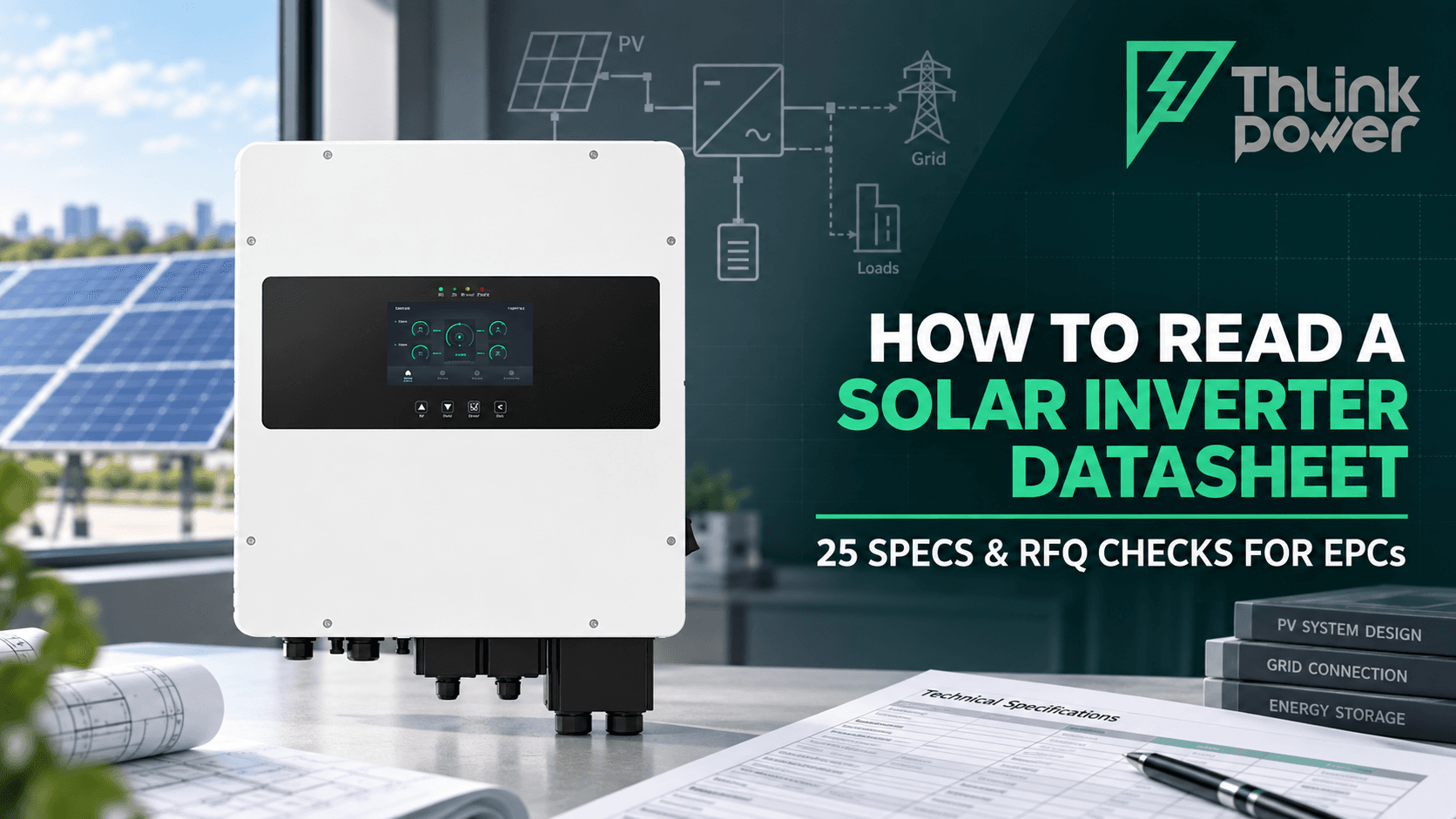
The inverter is the electrical interface between the array and the facility. Selection should begin with grid voltage and frequency, phase configuration, applicable grid code, array voltage, MPPT window, string current, environmental temperature, altitude, ingress protection, communications, and the required operating modes. Obtain the exact certificate and test report requested by the local utility or authority.
THLink Power reference data includes single-phase grid-tie models around 1–10 kW, three-phase grid-tie models around 4–15 kW, and three-phase hybrid models around 4–12 kW. One referenced three-phase family uses a 1000 Vdc maximum input and a broad MPPT range, while stated maximum efficiency varies by exact model. These values are not interchangeable. The EPC must complete the string calculation using the selected module’s voltage coefficients and site temperature extremes.
A capable solar inverter supplier should answer more than “compatible.” Ask for the supported grid profile, firmware version, battery protocol, export-control response, parallel-operation limit, fault logs, remote monitoring, spare unit strategy, and escalation path. If the project requires backup, clarify whether the inverter is grid-following or grid-forming, its overload duration, transfer time, black-start behavior, neutral/earth arrangement, and interaction with a generator.
Assign grid-code responsibility contractually. A product certificate does not by itself prove that the complete plant—including protection relays, transformer, controller, and settings—will pass the interconnection test. Name the party that prepares settings, attends witness testing, corrects nonconformities, and supplies the final settings report.
14. Battery procurement: separate nameplate energy from usable service
Battery offers love a large nominal-kWh number. The plant, however, receives usable service—at a stated power, temperature, state-of-charge window, age, and reserve. Say where capacity is measured. Is it DC at the battery terminals, or AC after inverter loss? Say when it must be available too: on commissioning day, at the end of warranty, or both.
Ask the solar battery supplier to draw the series/parallel arrangement and name the cell chemistry. Current limits, BMS protection, communications, thermal control, enclosure, and compatible inverter firmware go on the next page. For the selected country, add fire provisions, commissioning, remote data, transport classification, and compliance records.A bare cycle count is not evidence. Request its test conditions: depth of discharge, temperature, current, and the capacity left at the finish line.
For a commercial backup project, study worst-case operating sequences. After an evening peak-shaving event, will enough reserve remain for an outage? Can solar recharge the battery while the microgrid is islanded? How are high inrush loads started? What happens if communication between the energy-management system and BMS is lost? Can the generator charge the battery without unstable low loading? These questions belong in the factory acceptance and site acceptance plans.
Replacement planning matters even when the first installation is within budget. Put an assumed service life in the model, then move it earlier and later to see what breaks. The contract needs a capacity test and an allowed degradation path. It also needs a remedy, compatible replacement route, software support, and access to data. Broad cycle or warranty promises can wait until the model, duty profile, and contract are named; before that, they are only slogans.
15. Mounting and roof risk
Mounting is not a commodity afterthought. It is the route by which wind, snow, an earthquake, thermal movement, and a technician’s weight reach the structure below. Give the designer a roof drawing and tell them what the roof is made of, how old it is, and whether its warranty is still alive. Mark drains, fire zones, corrosion exposure, and any known structural limit. A qualified engineer must review the final design under the applicable local code.
Ask the solar mounting system supplier for material grades, coatings, fastener specifications, interface details, allowable spans, design loads, test evidence, bonding provisions, and installation tolerances. Confirm whether roof penetrations are allowed and who owns waterproofing. For ballast systems, verify additional dead load and sliding/uplift behavior; for penetrated systems, verify flashing and pull-out capacity.
Layouts must preserve access to drains, skylights, smoke vents, rooftop equipment, edge protection, and fire pathways. They should also permit module replacement and inspection. A few extra modules are not worth blocking a critical maintenance route. On corrosive coastal or industrial sites, check compatibility between aluminum, steel, fasteners, and roof materials.
The roof inspection should occur before commercial commitment, not after a deposit. If the site needs reinforcement or reroofing, include it in the investment case. Otherwise the project may appear economical only because an unavoidable building cost has been hidden outside the solar budget.
16. System design must connect the commercial promise to physics
Good solar system design turns load data and business requirements into an auditable energy and electrical model. It includes site layout, shading, loss assumptions, DC/AC ratio, string design, cable losses, protection, earthing, lightning protection, transformer loading, export control, monitoring, and expected monthly production.For hybrid systems it also includes an operating-state diagram and control narrative.
Challenge the yield sheet line by line. Which weather file was used? How was irradiance moved onto the plane of the array? The loss table should then expose soiling, heat, mismatch, cable, clipping, transformer, downtime, aging, shade, curtailment, and any bifacial gain. Insist on monthly output as well as the annual headline. The guarantee boundary should say which losses the contractor can control and which sit outside it.
Check voltage and current at extremes. Cold conditions raise module open-circuit voltage; high temperatures reduce voltage. Bifacial or high-current modules can challenge inverter input-current limits. Long cable runs and transformer choices affect loss and protection. The final design must agree with actual equipment revisions, not an earlier sales datasheet.
A design review should include operations staff. They know which roof zones leak, which switchboards are congested, when production shuts down, and which loads cannot tolerate interruption. Their input prevents a technically elegant drawing from becoming an operational nuisance.
17. Build the RFQ around deliverables
A useful RFQ makes offers comparable. Its first folder holds the interval file and bills. The next holds site coordinates, drawings, photographs, the single-line diagram, and transformer particulars.Grid rules, environmental conditions, any soil or structural report, the critical-load sheet, and the wanted commissioning date follow. Finally, write one unambiguous boundary on the cover: EXW equipment, delivered equipment, supervised installation, or turnkey EPC.
Ask every bidder to return the same schedule of values. Separate modules, inverters, storage, mounting, electrical balance of system, civil works, design, studies, logistics, duties, installation, testing, training, spares, monitoring, and O&M. Require model numbers and quantities. “Complete solar system” is not a sufficiently testable line item.
| RFQ package | Minimum buyer input | Required supplier output |
|---|---|---|
| Energy | 12–24 months interval data and bills | Monthly yield, self-consumption, export, peak impact, losses and sensitivities |
| Site | Coordinates, layout, roof/soil data, access constraints | Layout, structural basis, access plan, civil assumptions and exclusions |
| Electrical | Single-line, voltage, transformer and protection data | SLD, string schedule, cable/protection basis, grid compliance and settings responsibility |
| Commercial | Incoterm, destination, currency, tax and schedule | Itemized price, delivery plan, validity, payment milestones and assumptions |
| Quality | Applicable standards and witness points | Inspection and test plan, certificates, traceability, FAT/SAT and dossier index |
| Lifecycle | Service-level and data requirements | Warranty matrix, O&M scope, response time, spares, training and data ownership |
Require a deviations list. A bidder should explicitly mark every departure from the specification, rather than burying exceptions in general terms. Include an assumptions register and ask the bidder to price important options separately. This makes negotiation faster and exposes whether a low bid has silently excluded transformer work, export control, testing, or freight.
If working with a broad solar equipment supplier, nominate a single technical interface. Buyers should not be forced to solve compatibility disputes among the module, inverter, battery, controller, and monitoring providers. Responsibility for integrated function must be visible in the contract.
18. Compare landed cost, not the factory-gate number
The lowest quoted equipment price is not necessarily the lowest installed cost. Put every offer onto the same Incoterm first. Then walk one shipment, on paper, from factory packing to the final lifting point: inland truck, export papers, main freight, insurance, port, customs, unloading, storage, and the last trip to site. Give damage and exchange-rate movement their own allowances. Mark recoverable taxes separately and note when the cash returns.
Container utilization can materially affect module economics. Ask to see the packing drawing and recent photographs. It should disclose pallet count, dimensions, gross weight, stacking rule, and handling marks. Now test that package against the real journey: bridge limits, narrow gates, local trucks, and the forklift waiting at site. Batteries add another gate. Their dangerous-goods status, carrier approval, papers, and permitted storage conditions must work for the chosen route.
A lead time should look like a small programme, with dates and predecessors. Design approval releases the deposit; the deposit releases production. Inspection precedes the vessel booking. Transit and customs must meet a site that is actually ready, after which installation, the utility witness, and handover can occur.“Six weeks delivery” says almost nothing unless its clock and finish line are named. Leave float for approvals nobody on the supplier’s team controls.
A robust commercial solar system cost comparison also includes the buyer’s internal work. Management time, shutdown windows, crane coordination, temporary protection, utility studies, and roof remediation are real costs even when they do not appear on the supplier invoice.
19. Contracts: allocate each risk to the party able to manage it
Contracts should translate the technical offer into measurable obligations. Define scope, documents in order of precedence, deliverables, program, payment milestones, security, change control, acceptance, title and risk transfer, insurance, intellectual property, data access, confidentiality, warranty, performance remedies, delay remedies, liability caps, force majeure, suspension, termination, and dispute resolution.
Milestones should follow evidence. An equipment payment might require approved drawings and named models. A shipment payment might require packing list, inspection release, serial numbers, and transport documents. Completion should require passed tests, training, as-built drawings, settings files, passwords, spares, and the final dossier—not merely that panels are visible on the roof.
Performance guarantees need clear measurement rules. Define reference irradiance or the weather-adjustment method, meter accuracy, exclusions, availability, curtailment, grid outage treatment, degradation, test duration, and remedy.Avoid a guarantee that sounds precise but cannot be measured using installed sensors.
For PPAs, add lender rights, assignment, site access, roof work, energy-meter hierarchy, invoice dispute, change in occupancy, minimum offtake, deemed generation, curtailment, environmental attribute ownership, buyout schedule, and end-of-term removal. For owned projects, ensure product warranties and EPC remedies fit together. A ten-year product warranty does not automatically cover the labor and access cost of replacing a failed unit.
20. Commissioning: prove function before handover
Commissioning is where drawings meet the installed plant. Done properly, it gives both sides evidence that the system is the one approved and that it behaves safely. Write the inspection and test plan while details can still be changed, rather than drafting it when the crews are packing up. Place hold points before work is concealed. Records should cover torque, connectors, polarity, insulation, earthing, protection, labels, communications, export control, emergency stop, monitoring, and each promised operating mode.
For grid-connected PV, IEC 62446-1 provides a useful spine for the documentation, inspections, and commissioning tests. It sits beside—not above—local electrical and utility rules. See the IEC 62446-1 overview. In the specification, name the edition being used and list the country additions beside it.
Hybrid projects require scenario tests. Pull the grid. Repeat with a tired battery, then with a generator that refuses to start.Break a communications link, apply an overload, press the emergency stop, restore the grid, and recover from a protection trip. For every run, note which loads stayed live, transfer time, and the alarm seen by the operator. At handover, save a copy of every setting and write down each firmware revision.
Open the handover dossier and ask whether a new technician could run the plant from it. Approved and as-built drawings should sit beside model sheets, certificates, serial numbers, test sheets, protection settings, and manuals. Add named warranty contacts, the training register, spares, maintenance plan, and monitoring access. If every alarm still requires a call to the original installer for a password, handover is not finished.
21. Monitoring and performance governance
Think of monitoring as the project’s evidence file. Savings, warranty arguments, PPA invoices, and maintenance decisions all lean on it. A basic PV record needs inverter output, grid flow in both directions, appropriate weather or irradiance, availability, alarms, and revenue-meter readings. Storage adds its own diary: state of charge, power in and out, temperature, alarms, lifetime throughput, and whether the promised reserve was actually there.
IEC 61724-1 gives project teams a shared vocabulary for PV monitoring, along with equipment and measurement methods and several monitoring classes. Its 2021 edition updates areas including bifacial arrays, irradiance sensors, soiling, and availability. See the IEC 61724-1 overview.Choose a class because it suits the contract and the money at risk, not because a longer sensor list looks impressive.
Who owns the readings? Answer that before commissioning. Also set the retention period, sample interval, common clock, remote-access rules, security owner, alarm route, response target, and export format. The owner needs usable raw data, not only a colorful dashboard. Screenshots are poor evidence when performance is disputed.
Create a monthly operating review: expected versus actual energy; weather-adjusted performance; availability; curtailment; alarms; cleaning decisions; open defects; battery throughput; generator starts; and savings reconciliation. Assign one owner for actions. Monitoring creates value only when someone uses it.
22. Quality control for cross-border supply
For international procurement, agree inspections before production starts. One order may need only a document review and final sample. Another may justify material traceability, visits during assembly, finished tests, statistically selected samples, a packing check, and supervision as the container is sealed. Match that effort to the money at stake, the product risk, what is known about the factory, and the buyer’s own ability to inspect.
Verify certificate scope. Match manufacturer name, factory, model family, ratings, standard edition, issuing body, and validity to the offered product. Ask whether a design change affects the certificate. Local interconnection approval, import registration, fire rules, and battery transport documents may be separate from product safety certification.
Use an approved vendor-document register.Give every submission a number, revision, status, and due date. Freeze the bill of materials before production or agree how substitutions are approved. A changed connector may look minor; so may a cell, breaker, fan, or communications board. Each change still deserves one plain answer: does it alter compatibility, the certificate, the warranty, or the spares kept on site?
A crate will see rain, knocks, tilting, and more hands than anyone plans. Package for that journey and mark its lifting points plus storage limits. Tie each project packing list to serial numbers and the final site area; crews should not open six cases to find one controller. Photograph the load and the container seal. None of this is glamorous, and all of it saves time when something goes missing.
23. Operations, maintenance, and spare strategy
Write four names on the operating chart: the person watching alarms, the remote responder, the site technician, and the person allowed to shut the plant down. Separate calendar maintenance from work triggered by condition. Modules may need inspection and selective cleaning. Inverters need clear ventilation and an alarm review; switchgear follows the local maintenance regime. Mounting, roof interfaces, vegetation, and drains deserve their own walk-around.
Build the spares shelf from two facts: what stops the plant and how long a replacement takes to arrive. A city warehouse might keep fuses, surge devices, fans, connectors, a meter, and one communications board. A remote site may sensibly hold a whole inverter. Stocking everything wastes cash. Stocking nothing lets a cheap proprietary board keep a valuable array idle for months.
Ask a supplier to describe the first hour after an alarm. Who answers, during which hours, and what can that person see remotely? Then follow the case through a local partner, repair approval, return shipment, and expected replacement time. The warranty should say whether the incoming unit is new, refurbished, or repaired. It should also settle the awkward bills for labor, travel, lifting, freight, and customs.
Training should use the installed configuration. Operators need normal-start and shutdown procedures, alarm interpretation, emergency actions, backup-mode limitations, generator interaction, and safe isolation boundaries. Provide a short site-specific quick guide in addition to full manuals. Repeat training after staff turnover or major firmware changes.
24. Regional and site conditions can reverse the result
Local conditions determine which alternative works. High retail tariffs and strong daytime loads favor owned solar. Cheap reliable grids and short leases can favor grid-only service. Weak grids and expensive outages favor storage or generator support. Remote sites with costly fuel logistics often benefit from solar hybridization, even when financing is expensive.
Environmental conditions change equipment and structural choices. At altitude, cooling and electrical clearances deserve a second look. Hot modules lose voltage; hot inverter and battery rooms may also force derating. A coast brings salt, while farms may bring ammonia. Dust, humidity, flood level, cyclonic wind, snow, seismic demand, and industrial fumes each leave a different design mark.Give bidders design temperatures and a site exposure description, not merely the nearest city.
Regulation matters just as much. Confirm import rules, local content, grid approval, electrical licensing, building permits, fire access, environmental approvals, tax incentives, export compensation, land or roof rights, foreign-exchange controls, and PPA legality. A technically attractive structure can be unavailable in a particular jurisdiction.
Bring local professionals into the structural, electrical, tax, legal, and permit decisions. The overseas equipment team can help select products and assemble documents. It cannot sign for site-specific compliance in place of the licensed people who carry that duty locally.
25.Common procurement failure modes
| Failure mode | Why it happens | Control |
|---|---|---|
| Sizing from monthly consumption | Interval data is unavailable or ignored | Meter the load and model self-consumption by interval |
| Comparing unlike scopes | Offers hide exclusions in different places | Use a common boundary and returnable schedule |
| Assuming solar provides backup | Grid-following behavior is misunderstood | Specify islanding, critical loads, transfer time, and tests |
| Battery sized by kWh only | Power, reserve and event sequence are missing | Define the service and simulate worst-case operation |
| PPA chosen from first-year price | Escalator and termination terms are overlooked | Model full-term cash flow and operational scenarios |
| Generic certification claim | Certificate scope is not matched to model | Verify issuer, standard, factory, model and validity |
| Lowest equipment quote wins | Landed, integration and lifecycle costs are omitted | Compare total installed and present-value cost |
| No integrated responsibility | Multiple vendors blame interfaces | Name the system integrator and acceptance owner |
Another frequent problem is premature precision. A sales proposal gives an exact payback to two decimal places even though the roof survey, utility export rule, and interval load are unknown.Early-stage numbers should be ranges with stated assumptions. Precision comes after data quality improves.
Finally, buyers sometimes demand every possible feature. Complexity increases integration and training risk. Select functions that solve a measured business problem. A simpler plant with good documentation and accountable service often outperforms a feature-rich system that nobody understands.
26. A practical supplier scorecard
Price should be one section of the evaluation, not the whole decision. Weight the scorecard according to project risk. A typical commercial project might allocate points to technical compliance, modeled performance, relevant references, delivery plan, quality system, certifications, warranty and service, contract acceptance, financial capacity, and total landed cost. For a hybrid microgrid, increase the weighting for controls experience and scenario testing.
Score evidence, not presentation quality. A bidder receives full credit for a certificate only when it matches the offered model and jurisdiction. It receives full credit for yield only when the loss table and input data are disclosed. It receives full credit for service only when response commitments, personnel, parts, and escalation are documented.
Use clarification rounds consistently. Send the same material questions to all shortlisted bidders. Record the answer and whether it changes price or schedule. Invite operations, finance, legal, and engineering to score their own sections before the consensus meeting. This reduces the chance that one persuasive meeting overrides a material risk.
Before award, hold a contract-alignment workshop.Walk through the scope boundary, assumptions, exceptions, design responsibility, interfaces, delivery milestones, tests, documentation, warranties, and open conditions. The meeting is successful when the final offer has fewer ambiguities—not when it ends quickly.
27. When an off-grid system is the correct alternative
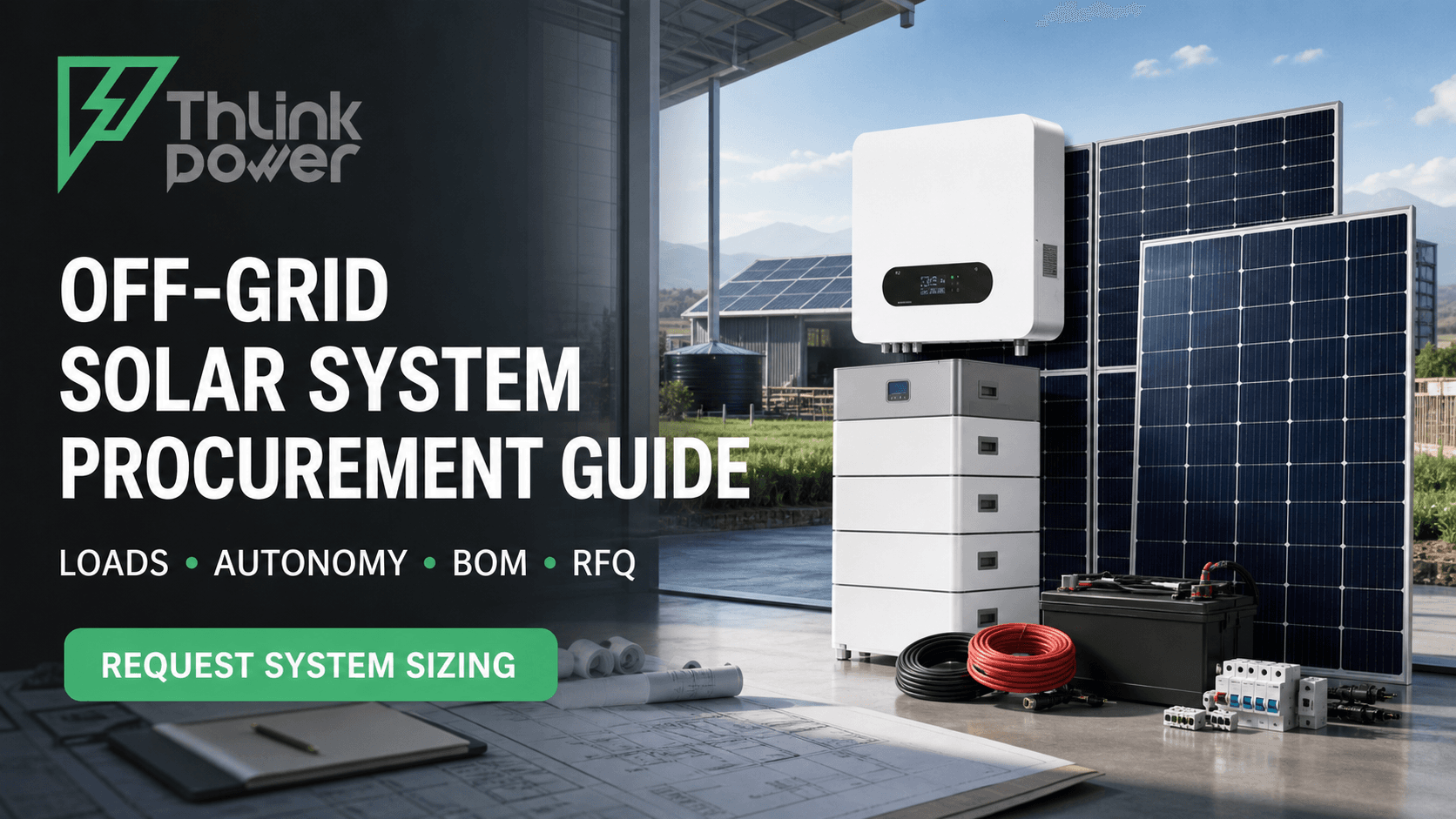
An off grid solar system is appropriate when no usable grid exists or when connection cost and lead time are unacceptable. It can also serve a clearly separated remote load. This is not an on-grid array with one cable omitted. Through several poor-weather days, the equipment must still balance energy and hold its own voltage and frequency; no utility is standing behind it.
Begin with a season-by-season load, then open it into hours. Mark motor starts, expected growth, available sun, tolerated loss of load, desired autonomy, and when a generator may run. Decide which work can move into bright hours and what must drop away at low state of charge. Efficiency has unusual leverage here: one avoided kilowatt shrinks generation, storage, inverter, and backup together.
Do not size storage by multiplying average daily energy by a desired number of days without considering usable depth, temperature, aging, conversion losses, peak power, and recharge capability. Model sequences of cloudy days and the generator’s role. A system with a modest generator may be more reliable and economical than an enormous battery bank designed for a rare weather event.
The operating rules must be easy for local staff.Remote monitoring, spares, service access, and fault recovery deserve high weighting. In a city, a failed controller is inconvenient; at a remote mine, farm, telecom site, or island facility, the same failure can stop the business.
28. Questions professional buyers should ask before approving a solution
- Open the model inputs: which meter file and tariff revision are there, and does the recreated bill match the real one?
- For each month, where does PV production go—into the load, the grid, curtailment, or the battery?
- Draw the scope line. Which Incoterm, destination, tax basis, and exchange-rate date sit behind the price?
- Name the offered hardware. Which model, firmware, certificate, and warranty document belongs to it?
- Who owns structural design, grid compliance, protection settings, controls integration, and final acceptance?
- What happens during a grid outage in daylight and at night?
- Which loads are critical, what is their peak and inrush, and for how long must they run?
- What assumptions drive the financial result, and at what break-even values does the decision change?
- How are underperformance, delays, component substitutions, and warranty labor handled?
- What data will the buyer own, and can raw data and settings be exported?
- What spares, training, response times, and local resources support the plant?
- What roof work, site change, production expansion, or contract transfer could affect the project?
No answer means no vendor award—not yet.Budget proposals can still be useful, provided every unknown is labeled and the price carries an honest allowance for it.
29. Questions that usually arrive at the bid meeting
Will ownership always beat a PPA on price?
No. Ownership often provides the lowest long-term energy cost when the buyer has suitable capital, stable occupancy, and good asset management. A PPA may provide better business value when capital has a higher internal return elsewhere or when the provider can manage construction and operating risk more effectively. Compare after-tax present value, risk allocation, and contract flexibility—not only the first-year price.
Can a grid-tied solar plant run the factory during an outage?
Usually not by itself. Standard grid-following inverters disconnect when the grid fails. Continued operation requires a designed island with an approved grid-forming source, protection, switching, controls, and an appropriate critical-load network. State this requirement before equipment selection.
When does a battery make commercial sense?
A battery may create value through demand reduction, tariff arbitrage, increased solar self-consumption, outage protection, generator optimization, or export limitation. It makes sense when those services are modeled with realistic dispatch, losses, degradation, reserve, replacement, and control requirements. Energy-only savings are not the only value stream, but benefits must not be double-counted.
How much load data is needed?
Bring one unbroken year of quarter-hour or half-hour readings to the first serious design meeting.Two years is worth the trouble when seasons move the load. Add bills, outage notes, production changes, and the machines that have not yet been installed. No interval record? Put in temporary meters before fixing the final size.
What should be inside the buyer’s quotation pack?
Start with the meter file and bills. Add a location pin, roof or land drawing, clear photographs, grid voltage, transformer particulars, and the current single-line diagram. A separate page should identify critical loads, outage target, site conditions, scope boundary, delivery point, Incoterm, required certificates, programme, and payment expectations. A preliminary price can live with gaps, but each gap needs a visible assumption.
How should buyers compare a diesel generator with storage?
Compare the service each provides. Diesel offers long-duration energy while fuel is available; storage offers fast response, silent operation, and efficient short-duration support but finite energy. Many outage-sensitive sites benefit from both: storage handles transitions and short events while the generator covers long outages. Model the actual sequence and maintenance readiness.
What is the most important PPA clause?
There is no single clause. Price escalation, minimum purchase, deemed generation, roof access, curtailment, assignment, termination payment, buyout, performance, and end-of-term obligations interact. Test the contract against plausible changes in production, ownership, roof condition, tariff, and law.
Should a buyer choose the highest-wattage solar module?
Not automatically.Evaluate total installed energy value, roof fit, handling, string compatibility, current limits, mechanical loading, warranty, certification, replacement availability, packaging, and landed cost. Higher wattage can reduce module count, but it is only one design variable.
Which standards should appear in the RFQ?
Use the standards and regulations applicable to the exact country and project. IEC 62446-1 and IEC 61724-1 can support commissioning documentation and performance monitoring, while product, grid, structural, fire, battery, transport, and electrical requirements require their own applicable standards. List editions and local additions.
How can an overseas buyer reduce supplier risk?
Verify the legal entity, factory, model-specific documents, references, quality plan, inspection points, packaging, integrated responsibility, warranty process, spares, and service escalation. Use milestone evidence and controlled substitutions. For a material order, consider independent inspection and local professional review.
Can a supplier guarantee Google ranking or project savings?
No responsible party can guarantee an organic search position, and no energy supplier should guarantee savings without agreed inputs and measurement rules. Buyers should expect transparent assumptions, auditable models, testable equipment performance, and a clear process for verifying results.
30.The information pack that produces a decision-grade proposal
For an initial review, send the site country and coordinates, business type, twelve months of bills, interval load file, operating hours, roof or land area, photographs, grid voltage, transformer capacity, outage history, critical-load list, target service, planned expansion, preferred ownership or PPA structure, delivery destination, and target schedule. Remove confidential identifiers if necessary, but keep time intervals and tariff components intact.
THLink Power can use that pack to discuss an equipment and system approach covering modules, inverters, storage, and integrated solutions. Any preliminary sizing remains subject to site verification, local engineering, grid approval, exact product selection, and commercial confirmation. MOQ, price, lead time, certification, warranty, and performance should be confirmed for the named model and destination.
If your team is still comparing alternatives, say so. A useful first response does not force a single architecture. It identifies missing information, screens ownership against PPA and grid supply, tests whether storage solves a real service problem, and separates emergency diesel capacity from everyday energy. That is the shortest route to a quotation that management can trust.
Request a Commercial Solar System Proposal
31. Final decision rule
Choose ownership when control, long site tenure, and lifecycle savings outweigh the capital and asset-management burden. Choose a PPA when capital preservation and risk transfer are worth the long-term contract.Keep grid-only supply when reliability and tariffs are acceptable and the site cannot support a durable project. Keep diesel for firm, dispatchable backup or remote duty, not as an automatically cheap energy source. Add storage only after its service, dispatch, reserve, and replacement case are explicit.
Most importantly, compare complete systems on the same boundary. Start with measured demand. Price reliability. Verify the roof and grid. Name exact equipment. Allocate interfaces. Test operating modes. Keep the financial model auditable. Some uncertainty will remain; the job is to drag it into view while there is still time to price, assign, or reject it.
Use this guide at the early B2B procurement stage. It does not design a particular site or replace the engineer, lawyer, tax adviser, finance team, safety specialist, or grid authority responsible for that project. Final decisions need local professionals and confirmed equipment documents.