Short answer: a container purchase should be specified backward from the buyer's market and project, not forward from the cheapest price per watt. Freeze the module code, electrical limits, dimensions, packaging version, label set, traceability, inspection plan and commercial basis before comparing offers. The container is not the unit of quality; the serial-numbered module is.
This guide is for distributors, importers, EPC procurement teams and project developers sourcing solar panels wholesale. It explains how to compare module families, convert a project demand into a packing plan, control substitutions, inspect production and manage arrival claims. It uses published THLinkSolar catalogue data as sourcing examples while keeping every price, certificate, warranty and delivery promise subject to model-level confirmation.
Request Module Selection, Packing Plan and Container Pricing
1. Define the buying job before asking for price per watt
A distributor buying for resale needs a product range that installers can stock, explain and replace. An EPC buying for one roof needs an exact module compatible with the approved layout, structure and inverter. A developer may prioritize bankability, serial traceability and long-term claims. The wattage can overlap while the procurement job differs.
Write down the destination market, applications, annual volume, first-order quantity, required arrival date, port, preferred Incoterm, local product rules and customer expectations. Then identify any hard constraints: roof area, module length, pallet-handling limit, container height, clamp zones, color, connector family, maximum system voltage and required documentation.
2. Compare modules as complete mechanical and electrical products
Two modules can both say 545 W on the carton and still create different work on the roof. Lay the drawings side by side: size, current, voltage, frame, cells, connector, glass and the pack can all move. Strings, rails, clamps, cable and replacement stock move with them. Put the full model code and watt class on both the quotation and the pro forma invoice.
Open the catalogue and seven mono families appear. At one end is the 360-380 W band; at the other is 525-545 W. The common notes mention 3.2 mm low-iron tempered glass and an anodized frame. Junction-box wording is IP67/IP68, and the cable line says 4 mm². The same pages show 1500 V, a 20 A series fuse and 0 to +3 W tolerance. Circle the entries again on the model sheet that comes with the quote.
| Buying use | Catalogue example | Packing reference to recheck |
|---|---|---|
| Fewer modules per MW | YH525W-545W-36MH | 620 pieces / 40HQ |
| Mid-size commercial roofs | YH430W-460W-36MH | 726 pieces / 40HQ |
| Compact handling and resale | YH360W-380W-30MH | 858 pieces / 40HQ |
Important: treat the last column as a planning note, not a promise to ship. The pack may have changed. Ask the factory to redraw the actual pallets and show cartons, corners, payload, route limits and the current revision. Sign that plan before freight is booked.
3. The newest watt class is not automatically the cheapest roof
More watts per module can mean fewer pieces for the same DC total. Before celebrating, put its drawing over the roof plan and its current beside the inverter limit. One installer may save clamps. Another may lose the last row or need a bigger lifting crew. Compare the installed job, including labor and structure, rather than choosing the newest number.
For a distributor, range simplicity matters. Carrying several near-identical watt classes fragments stock and complicates replacements. Map each proposed SKU to common inverter current limits, residential or commercial roof dimensions, local installer preference and pallet economics. Keep a controlled replacement rule: “same watts” is not enough if dimensions or electrical characteristics change.
4. Freeze the electrical design before approving a substitute
The module datasheet must feed the project string calculation. Record Voc, Vmp, Isc, Imp, temperature coefficients, maximum system voltage, fuse rating and connector. Calculate the maximum cold string voltage, hot operating voltage and current per MPPT. A late module substitution can invalidate the approved string length even when the nameplate wattage is unchanged.
The THLinkSolar catalogue lists common temperature coefficients of Pmax -0.350%/°C, Voc -0.270%/°C and Isc +0.048%/°C, with a published NOCT of 45±2°C. Use the exact model's current document and the project's design temperatures. The module operating temperature, rather than the daily air-temperature headline, drives hot-voltage and energy calculations.
Coordinate with the solar inverter supplier before a mixed purchase. Modern high-power modules may challenge input-current limits while older inverters were designed around lower-current strings. Connector count, string-input count and MPPT count are not interchangeable terms. Put the approved module-inverter matrix in the procurement file.
5. Mechanical dimensions affect more than container quantity
Length, width, thickness and mass influence roof layout, walkway clearance, wind zones, rail spacing, clamp range and handling. Send the exact module drawing to the solar mounting system supplier. The structure must be calculated from site wind, snow, roof or soil conditions and corrosion basis; a module's published load rating does not approve the roof.
A 27.2 kg module may be routine in a warehouse and awkward on a windy roof. Review local lifting methods, team size and breakage risk. Larger modules can produce more power per piece but may increase the cost of damaged-module replacement or require different rooftop logistics. Procurement should measure installed cost per watt, not just ex-works module cost.
6. Read the certificate annex, then look at the factory routine
IEC 61215 is a familiar starting point for terrestrial module design qualification. IEC 61730-1:2023 and IEC 61730-2:2023 deal with safety construction and testing. IEC 62941:2019 turns to the manufacturing quality system behind qualified modules. These titles tell a buyer what evidence to ask about; they do not put an unlisted model onto a certificate.
Request the certificate, test report or certificate annex that identifies the exact model family, construction and manufacturing site. Check issue date, edition, certificate holder and laboratory. If a bill of materials changes, ask how the change is controlled and whether the certified construction remains covered. Marketing logos alone are not model-to-certificate traceability.
Factory evidence worth requesting
- Incoming inspection rules for cells, glass, encapsulant, backsheet or rear glass, frame, junction box and connectors.
- Approved BOM and change-control process tied to the quoted model.
- Calibration status for flash testers, electroluminescence equipment and safety-test instruments.
- In-process controls for layup, lamination, framing, junction-box bonding and curing.
- Final flash, EL, visual and insulation/safety test records linked to serial numbers.
- Nonconformance, rework, quarantine and corrective-action records for the production lot.
7. Convert a project demand into an auditable container plan
Begin with the exact number of modules required by the approved design, then add the project's agreed spare quantity. Convert modules to pallets using the current packing specification. Convert pallets to containers while checking internal dimensions, gross payload, axle and road limits, lifting method, dunnage, desiccant and route restrictions. Do not round only on wattage; round on physical packs.
A packing plan should show module code and watt class, pieces per pallet, pallet count, pallet dimensions, net and gross weights, container type, loading orientation, blocking/bracing and container seal process. If partial pallets are permitted, specify how they will be protected. The plan must match the commercial invoice and packing list.
| Packing-plan item | Buyer question | Evidence before shipment |
|---|---|---|
| Pieces per pallet | Is this the current model's standard pack? | Packing drawing and sample photos |
| Pallet dimensions / mass | Can warehouse and site equipment handle it? | Net/gross weight declaration |
| Pallets per container | Is payload and route limit respected? | Load plan with container type |
| Protection | How are glass, corners, frames and cartons restrained? | Edge/corner protection and bracing spec |
| Moisture control | How will condensation risk be managed? | Dry-container check and desiccant plan |
| Traceability | Which serials are in each pallet? | Pallet-to-serial mapping |
8. A mixed container can work, provided the warehouse can untangle it
A distributor may use the first container to test two or three products. Keep every model on its own pallet. Give the outer label a bold SKU and watt class, then add a load map showing where that pallet sits. Loose mixed cartons look flexible at the factory and become a receiving and claims puzzle at the port.
For project supply, mixing watt classes can create array mismatch and installation errors. If multiple watt bins are accepted, define how they will be grouped into strings and recorded. Do not allow an unapproved lower watt class to be hidden by an average shipment wattage. Count and identity should be visible before the container is sealed.
9. Build a landed-cost model that exposes exclusions
Price per watt must use the same commercial basis. Confirm currency, Incoterm, origin port, destination, freight-validity date, insurance, bank fees, duties, taxes, inspection, local transport, storage, handling, breakage allowance, spare stock and financing. A small difference in ex-works price can disappear after container utilization or port charges.
Include the installed effects of size and current. A higher-power format can reduce module count while requiring different lifting, rails or inverter inputs. For a commercial solar system, the buyer should compare total installed and operating value. Published commercial solar system cost figures from another country rarely include the same freight, structure, labor, taxes or finance.
Normalize every quotation
- Exact model and total nameplate watts.
- Pieces, pallets, container count and gross payload.
- Commercial term, port, currency, quote validity and payment schedule.
- Included labels, connectors, spare modules, documents and inspection.
- Lead time definition: deposit to production, production to shipment, or estimated arrival.
- Warranty, claim evidence, replacement route and freight responsibility.
10. Pre-production sample and golden sample
A sample should match the planned construction and label set. Inspect dimensions, frame, glass, junction box, cable, connector, workmanship, serial format and packaging. Record electrical results and photograph details. If the production order changes BOM, watt class, label, connector or frame, decide whether the sample remains representative.
Keep an approved golden sample or an equivalent signed specification. Its purpose is not to replace drawings and tests; it gives factory, inspector and buyer a common visual reference. Mark the sample's serial and revision, and prevent it from being accidentally shipped as ordinary stock.
11. Write a pre-shipment inspection plan before production
Inspection scope should be agreed in the purchase order, not negotiated after the modules are packed. Define lot, sampling method, defect classification, acceptance limits, test sequence, equipment, record format and reinspection rule. Critical electrical or safety defects may require zero acceptance even where cosmetic defects use a sampling plan.
Do not depend on one top-of-pallet visual check. Select serials across production time and pallets where feasible. Keep the selection process independent of the packer. If an inspector cannot safely access modules after packing, schedule the inspection before final closure or require controlled unpacking and repacking.
Typical inspection layers
- Identity: approved model, watt class, label, serial, BOM revision and order quantity.
- Visual: glass, cells, ribbons, back surface, frame, sealant, junction box, cable, connector and cleanliness.
- Dimensional: overall size, thickness, frame straightness, mounting holes and cable length.
- Electrical: flash data at controlled conditions, insulation/safety tests and sample comparison to the agreed tolerance.
- EL: agreed criteria for cracks, inactive areas, soldering anomalies and image traceability.
- Packing: count, protection, pallet integrity, labels, serial map, container condition and seal.

12. Flash data, watt bins and serial traceability
Require a flash list for the shipment with serial number, measured Pmax, Voc, Isc, Vmp and Imp as applicable. Confirm the test method, calibration and reference conditions. The list should reconcile to the packing list. A summary average cannot locate an outlier or support a later claim.
Define the accepted watt tolerance and binning rule. The THLinkSolar catalogue states a 0 to +3 W power tolerance for the referenced families; verify the final model document and commercial order. If the buyer accepts multiple watt classes, state the price and packing treatment for each class.
Traceability should connect raw and process records to a serial or production batch and connect serials to pallets and containers. The goal is not paperwork volume. It is the ability to identify affected modules if a component, test or transport issue appears after delivery.
13. Electroluminescence inspection: define what a pass means
EL imaging can reveal cracks, interrupted fingers, inactive regions and soldering anomalies that are not visible in ordinary light. It is not useful as a vague promise. Specify whether images are captured before lamination, after lamination, after framing and/or before shipment, and whether the buyer receives images for all modules or a sample.
Agree on image naming and criteria. Cracks differ in orientation, length, isolation and risk; not every visible feature has the same consequence. Ask the technical team to define reject, review and accept categories with examples. If modules are reopened after a passed EL test, decide whether a repeat test is required.
14. Packaging protects glass, cells, frames and evidence
Solar modules experience vibration, shock, stacking, humidity and multiple handling events. Packaging must restrain the pack without concentrating damaging forces. Inspect corner protectors, separators, straps, carton, pallet base, wrapping and blocking. Check that forklifts can enter safely and that lifting instructions are visible.
Moisture is easily overlooked. A dry container can still see condensation as temperature changes. Agree on container inspection, desiccant and packaging materials appropriate to the route. Photograph the empty container floor, walls and roof before loading, then photograph each loading stage and the final seal.
15. Freight booking, insurance and shipping documents
Book freight from a confirmed cargo-ready date and validated gross weight. Module deliveries are bulky, and demurrage, detention or rolled bookings can affect a project's schedule. Clarify who provides export customs, origin charges, insurance and destination documents under the selected Incoterm.
The document pack commonly includes commercial invoice, packing list, bill of lading, certificate of origin where applicable, insurance certificate when included, product documents and inspection records. Destination markets may require additional conformity or registration documents. Use a qualified forwarder and local importer; do not assume one country’s paperwork fits another.
16. Receiving inspection preserves claim rights
The receiving team should know the claim procedure before the vessel arrives. Record container number and seal, external condition, opening sequence, moisture, shifted pallets and visible damage. Photograph continuously. If damage is material, notify the carrier, insurer and supplier within the required time and avoid discarding packaging evidence.
Reconcile pallet and serial counts. Sample modules from more than the easiest pallet. Check frame corners, glass, back surface, junction box, cables and connectors. If transport damage is suspected, agree on EL or electrical retesting before installation. Separate quarantined modules and keep their serials out of the installation list.
17. Installation feedback closes the procurement loop
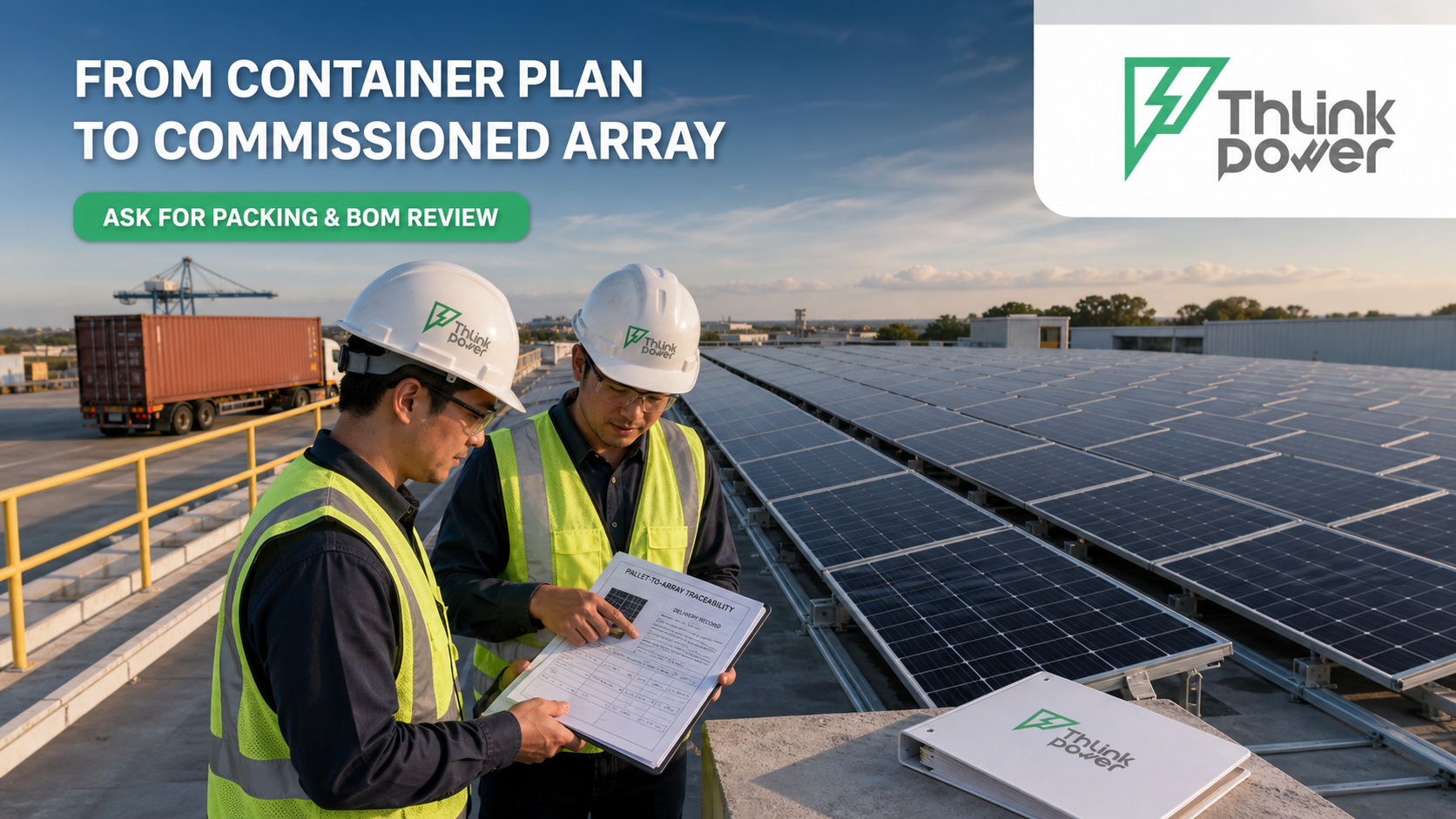
Procurement quality is not complete at the port. Ask installers about handling, clamp fit, connector mating, cable length, module squareness and breakage. Compare installed serials to pallet records. If one pallet produces repeated issues, that correlation is valuable for both supplier corrective action and future packing design.
The solar system design team should receive the final module revision and flash list. The solar mounting system supplier should receive the final drawing and clamp instructions. The solar inverter supplier should receive the final electrical data. One controlled handover prevents three separate parties from designing against obsolete information.
18. Warranty review: read the process, not only the years
A long headline warranty has limited value if the buyer cannot prove eligibility or pursue a claim. Review product and performance coverage, start date, degradation basis, exclusions, required installation records, notice period, evidence, testing method, remedy, labor, transport and jurisdiction. Ask how an importer or distributor handles an end-customer claim.
Keep invoice, packing list, serials, flash data, inspection records, installation date, photos, monitoring and maintenance. Do not promise end customers a broader warranty than the supplier contract. If a private label is used, state which party carries the legal and service responsibility in each market.
19. OEM and private-label orders need change control
OEM may cover label, carton, manual, color, connector, cable, frame or BOM options. Each change can affect certification, tests, MOQ, lead time and spare compatibility. Create a signed artwork and technical-configuration approval. Proofread electrical ratings and legal marks separately from marketing copy.
An experienced solar panel manufacturer should explain which changes are cosmetic and which create a new qualified construction. Request pre-production label photos and final packing photos. Reserve serial ranges and replacement labels under controlled access; poor label governance creates counterfeit and warranty risk.
20. Red flags in wholesale module quotations
- Price per watt with no exact model, watt class, quantity, term or validity.
- A certificate logo without a certificate or annex naming the proposed family.
- An easy promise to substitute “equivalent” cells, connectors or backsheets.
- Container quantity that is not supported by a current packing drawing and gross weight.
- Lead time described as “fast” without defining deposit, production completion or shipment.
- Warranty language that omits claim evidence, remedy, freight and local responsibility.
- Refusal to provide serial mapping, flash data or a reasonable inspection window.
- Pressure to accept a different module after structure or string design is frozen.
21. A professional wholesale-panel RFQ
- Buyer and market: importer, distributor or EPC; destination country, port and intended application.
- Technical specification: exact family or dimensional/electrical limits, watt class, construction and connector.
- Quantity: modules, project spares, pallets, first order and forecast.
- Documents: datasheet, drawings, model-specific certificates, warranty, installation manual and label sample.
- Quality: approved BOM, change control, flash/EL/visual plan, serial list and third-party inspection access.
- Packing: pieces per pallet, dimensions, weights, pallets per container, protection and loading photos.
- Commercial: currency, Incoterm, port, payment, validity, lead-time definition and price by watt class.
- Logistics: cargo-ready window, container type, insurance, documents and destination requirements.
- Warranty/service: claim route, evidence, remedy, freight, response and spare-module policy.
- OEM: artwork, legal marks, sample approval, MOQ, change effect and responsibility.
Send this matrix to each shortlisted solar equipment supplier. Require stated deviations. Where a supplier lacks a product in the total package—battery, inverter, mounting or monitoring—name the interface owner. A one-stop offer is useful only when the boundaries are visible.
22. Frequently asked questions from B2B buyers
How many panels fit in a 40HQ container?
It depends on module dimensions and the current packaging. THLinkSolar's catalogue references range from 620 pieces for the 525-545 W family to 858 pieces for the 360-380 W family. Treat those as planning references and request a signed current packing plan, weights and load drawing.
Should a distributor buy only the highest wattage?
Not automatically. Balance installer demand, roof fit, inverter current, handling, container utilization, replacement stock and price. A simpler range with stable supply can outperform a crowded catalog of marginal wattage differences.
Is third-party inspection necessary?
Risk, order size, relationship maturity and project requirements decide. Even when the supplier runs strong internal QC, a buyer should define evidence, sampling and acceptance. Independent inspection can add confidence but does not replace a precise specification.
Can module brands be mixed in one array?
The engineer must evaluate electrical matching, string design, mechanical fit, connectors and warranties. Do not mix based only on wattage. Replacements should follow an approved rule and be documented in the as-built records.
What makes a high-quality inquiry?
Destination market and port, buyer type, application, target wattage or dimensional limits, module quantity, timeline, required certificates, Incoterm, OEM needs and inspection expectations. Sharing the inverter and mounting constraints makes the recommendation faster and safer.
23. Module technology language: require a construction, not a buzzword
Terms such as mono, half-cut, PERC, TOPCon, bifacial and multi-busbar describe parts of a construction or technology approach. They do not by themselves establish energy yield, durability or compatibility. Ask for the exact datasheet, bill-of-material options, qualification scope and warranty tied to the quoted code. If a cell technology changes between sample and production, treat it as a controlled change.
Bifacial products require additional system inputs: rear-side construction, bifaciality, ground reflectance, mounting height, row spacing and rear shading. Do not add a generic percentage to expected yield. Use a suitable energy model and document the assumptions. For monofacial modules, verify that marketing imagery does not accidentally imply a double-glass or bifacial construction that is not in the order.
High current is another point where fashion can outrun system fit. A module may deliver more watts with a current that exceeds the intended inverter input arrangement. The module team and inverter team should sign the same string matrix. That interface matters more than whether the cell technology has a newer name.
24. Distributor inventory and replacement strategy
A distributor should forecast in pieces, watts, pallets and months of demand. Segment by real installer use: residential roof size, commercial roof, off-grid kit, inverter compatibility and price band. Slow-moving near-duplicate SKUs consume cash and warehouse space. A controlled core range plus project-specific orders is usually easier to support.
Plan replacements before the first sale. Record dimensions, frame, connector and electrical range for each SKU. Keep a small spare ratio for project orders where appearance and fit matter. When a model is discontinued, establish a written replacement matrix and require an engineering check rather than telling installers to use “the next wattage up.”
Warehouse practice affects claims. Store pallets as specified, keep them dry, protect labels, restrict double stacking unless approved and train forklift operators. Maintain serial location records. If modules are split from a pallet, create a new internal pallet map instead of losing traceability.
25. Inspection sampling and defect classification
Sampling plans should reflect the risk of each characteristic. A cosmetic frame mark and a safety insulation failure should not share one acceptance rule. Define critical, major and minor defects with examples. Set the lot and sample before the inspector arrives. Where a critical defect is found, the response may require containment or expanded testing rather than accepting an average.
Inspection teams should avoid tester-to-tester ambiguity. Provide visual standards, lighting conditions, measurement method, calibrated tools and photo angles. For EL review, use consistent exposure and naming. For dimensions, name the datum and tolerance. For packaging, specify what counts as a crushed corner, loose strap or unacceptable moisture sign.
When a lot fails, require root-cause analysis, correction, segregation and reinspection. Reworking cartons without addressing a packing-process problem may only hide evidence. Record the old and new pack status and any serial movement so the final mapping remains reliable.
26. Commercial project scenarios that change the best module choice
Space-constrained commercial roof
High efficiency and usable module geometry may matter more than the lowest module price. The designer should test row layout, setbacks, fire access, obstruction zones and inverter inputs. A few more watts per module have value only if the roof can use them.
Large open industrial roof with labor constraints
Larger formats may reduce pieces and some handling steps, but wind, roof loading, team lifting and rail design still decide. Ask the installer for productivity assumptions and breakage experience. Model the cost per installed watt.
Remote off-grid distribution
Robust packaging, replaceability and matching to available inverters may matter more than the newest watt class. If roads are rough or manual unloading is common, pallet and module handling should be tested against that route. Coordinate with the off grid solar system BOM rather than selling panels in isolation.
Multi-country distributor program
Country rules, customer expectations, language, labels and warranty responsibility can differ. Keep a market-to-model document matrix. Do not use one private-label pack in several countries until legal marks and manuals are checked for each destination.
27. Quote-comparison scorecard
| Decision area | High-quality response | Warning sign |
|---|---|---|
| Model identity | Full code, revision, construction and watt class | Generic 550 W panel |
| Compliance | Exact certificate annex and current documents | Unmapped logos |
| Quality | BOM control, calibrated tests, serial data and inspection access | Only factory photos |
| Packing | Signed pack drawing, weights and load plan | Container quantity in chat |
| Commercial | Clear Incoterm, port, validity, inclusions and lead-time basis | One price with no basis |
| Warranty | Evidence, remedy, timeline, freight and responsibility | Years only |
| Interfaces | Final data shared with inverter, structure and design teams | Buyer must solve everything later |
Keep fatal requirements outside the weighted score. If the model does not satisfy a mandatory dimension, current limit, certificate or delivery constraint, its lower price should not win. Use the scorecard to distinguish otherwise compliant offers and document why the award was made.
28. Country and climate checks before a catalog becomes an order
A module suitable in one tender may need different evidence, label language or mechanical design in another. Ask the importer or local engineer to identify mandatory product registration, electrical standards, fire rules, building permits and customs documents. Confirm whether the project specification adds requirements beyond law. The supplier can prepare documents only when the destination and authority are known.
Hot climates place more weight on operating temperature, ventilation and the Pmax temperature coefficient. Cold climates drive maximum string voltage and snow review. Coastal sites need a corrosion and salt-mist discussion. Agricultural buildings may expose modules to ammonia or dust. High altitude changes irradiance, temperature and sometimes electrical clearances. Write these conditions in the RFQ rather than assuming the word “outdoor” covers them.
Wind and snow numbers must come from the project design basis. The catalogue's 2400 Pa wind and 5400 Pa snow references are product test/load information, not a complete roof calculation or permission to use the same mounting arrangement everywhere. The structural engineer must use the correct code, pressure distribution, support geometry and safety factors.
29. Build one product file that sales and the warehouse will both open
Our first page is a plain index with revision dates. It points sales to the approved photos and claims, the warehouse to the pack drawing and pallet dimensions, and support to serial format, string inputs and the replacement rule. The same folder holds the data sheet, manual, model certificate set, warranty and label art. Give it an effective date so an old copy is obvious.
Add a claims checklist for installers: invoice, module serial, array position, photographs, electrical measurements, monitoring evidence and the steps that must not be taken before supplier review. This prevents well-meaning field teams from discarding labels or moving a suspected module without recording its location.
Sales should quote only what that file proves. If the annex does not name the SKU, leave the certification claim out. If the packing drawing is still under review, do not promise the container count. This restraint is good protection for the distributor, and professional buyers notice it.
30. When a tender asks what is behind the word sustainable
Some tenders ask about material sourcing, factory energy, environmental management, recycling or supply-chain checks. Ask which clause or reporting framework they mean. Then answer for a named factory and period, with third-party assurance where it exists. A solar module is a renewable-energy product; that fact alone does not prove every claim about its supply chain.
Packing creates a smaller, very practical discussion. Fewer materials may reduce waste and freight, but not if the panels arrive broken. Ask whether the pallet and carton can be reused or recycled where they land. If a lighter pack is proposed, look for transport validation before approving it. One replacement shipment can erase the saving.
31. Why the next step should be a technical-commercial review
THLinkSolar's range covers the familiar residential and commercial module bands, with inverters, storage and complete systems in the wider offer. That can reduce the number of interfaces an importer manages. It does not remove the need to lock the exact models and evidence. On the review sheet, each open line is marked “confirmed,” “assumption” or “buyer input due.”
For projects that include storage or backup, add the solar battery supplier requirements and the off grid solar system load brief to the same review. Procurement becomes more reliable when modules, inverter, battery and structure are checked against one system basis rather than purchased as isolated catalog items.
What to attach to a container-price request
Attach the destination country and port, buyer type, target module dimensions or project drawing, preferred watt range, required quantity, first-order timing, inverter model, mounting constraints, certificate list, OEM artwork needs, inspection expectations and desired Incoterm. If the purchase is for several projects, separate firm demand from forecast.
Ask the supplier to return one response pack: quotation, exact model datasheet, certificate mapping, packing plan, net/gross weights, pallet count, production lead-time basis, warranty and deviation list. Keeping these files together prevents a sales message from being mistaken for a contractual specification.
Before paying a deposit, confirm that the pro forma invoice and technical annex match. Model, watt class, pieces, price basis, term, port, packing, label, inspection and document deliverables should tell the same story. If a later change is required, approve it through a dated change note and revisit any affected string, structure, certificate or shipping calculation.
Request a Wholesale Module Comparison, Packing Plan and B2B Container Quote
Sources and scope: module ranges, dimensions, weights, general construction and catalogue container quantities are based on the THLinkSolar PV Modules Catalogue reviewed for this article. IEC 61730-1:2023, IEC 61730-2:2023 and IEC 62941:2019 are cited for their published scopes. Final models, certificates, packaging, warranty, prices, stock, MOQ, Incoterms and lead time must be confirmed in the current quotation and purchase order.
Put a revision date on the datasheet, pack drawing, label art, warranty and technical annex. Keep the signed set beside the purchase order and inspection report. If either side changes a page after deposit, use a short change note: why it changed, who agreed, and which string, structure, certificate, artwork, test or shipping item was checked again.
Think of traceability as a trail the receiving team can walk backward. An array position points to a serial. The serial points to a pallet and a container. Behind it sit flash data, the approved model and the customer's original specification. Keep that trail intact and commissioning questions are easier to answer. Claims have evidence, and the next order improves from records rather than memory.
One last habit helps: after the first shipment, hold a short review with sales, warehouse, EPC and service. Record what the forecast missed, what arrived damaged, which documents were late and which SKU moved fastest. Feed those notes into the next specification and packing plan.