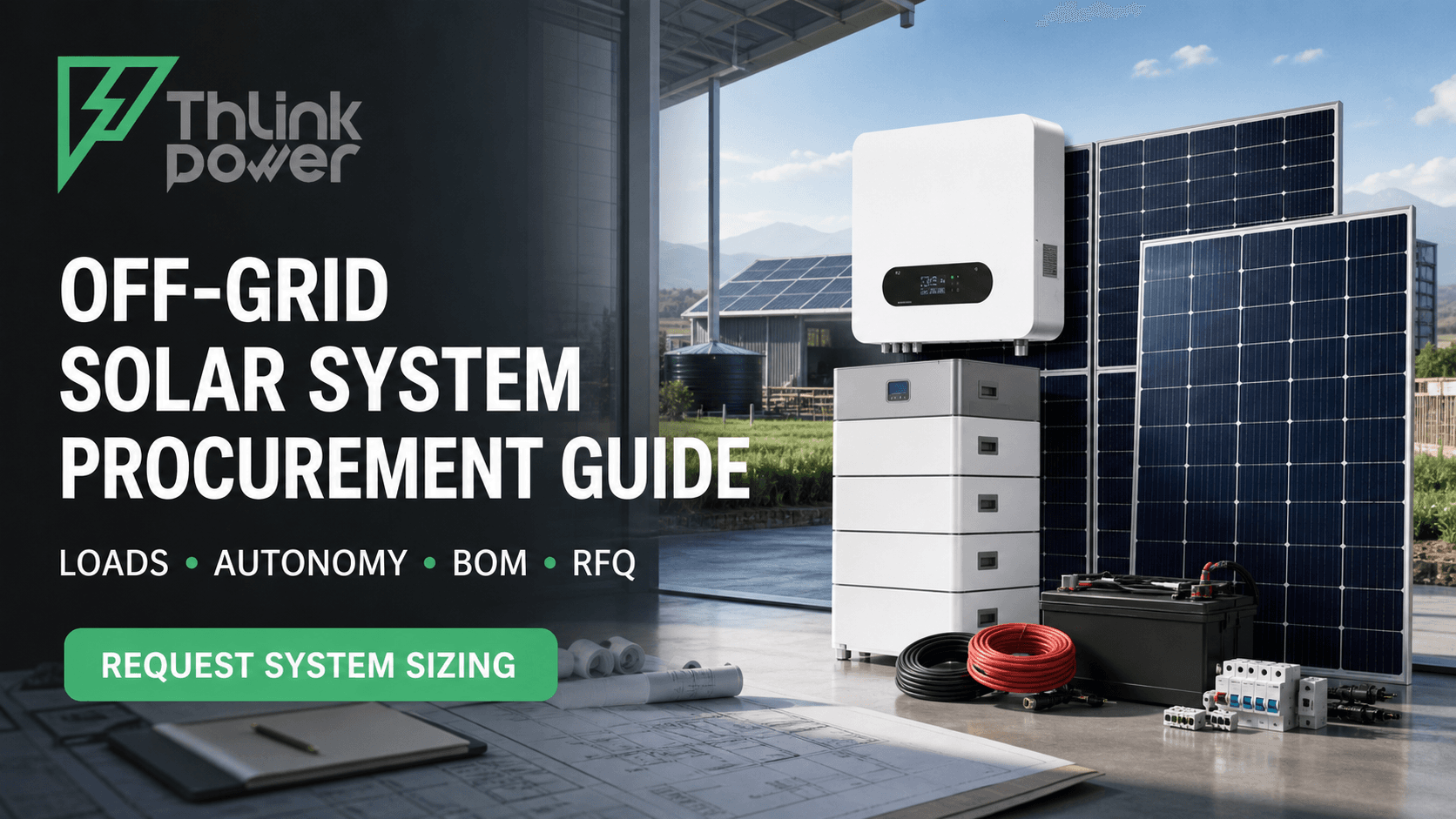
Short answer: an off-grid quotation is only useful after the supplier understands the loads, the hours those loads run, motor starting demand, the weakest solar month, the required autonomy and the consequences of an outage. “20 kW off grid” names an inverter class; it does not define a reliable power plant. This guide shows importers, EPC teams, distributors and remote-project owners how to turn field data into a comparable BOM, a testable acceptance plan and a responsible RFQ.
The method is deliberately practical. It separates facts supplied by the buyer from assumptions made during preliminary sizing. It also distinguishes the energy calculation from the instantaneous-power calculation. A clinic refrigerator, irrigation pump, telecom rectifier and village shop may consume the same daily kilowatt-hours, yet they produce very different inverter, battery and operating requirements.
Send Your Load Table and Site Data for an Off-Grid System Review
1. Begin with a service brief, not a shopping list
An off grid solar system is a small utility with one customer. It makes power, saves some for later and holds the local AC bus together. It also has to remain safe on the worst day the site is likely to see. Procurement therefore starts with the service the owner needs. A list of components comes later.
Write the service brief in plain language. State what must stay on, when it must stay on and what may be shed.Note whether the owner accepts a generator start during a long cloudy period. Identify the person who will operate the plant after the EPC team leaves. Those statements often change the design more than a headline price-per-watt target.
- Site: mark the coordinates and elevation; then describe the road, heat, damp, dust, salt and security in words an installer will recognize.
- Electrical service: write down measured voltage, phase and frequency. Add the earthing sketch and photograph the existing generator plate.
- Loads: measured running power, starting method, duty cycle, operating schedule and criticality.
- Reliability: autonomy target, acceptable outages, load-shedding rule and generator policy.
- Commercial scope: quantity, destination port, required delivery date, installation responsibility, OEM needs and documentation.
2. Build a load audit that an engineer can defend
A useful load audit records appliances and machines one by one. Nameplate power is a starting point, not always the answer. Compressors cycle, pumps start against different heads, welding loads are intermittent and telecom equipment can have a steady base load. When possible, measure current and energy over representative days. Keep photos of nameplates and the meter export with the design file.
Separate daily energy from peak demand. Daily energy determines how much generation and storage are required. Peak demand and surge determine whether the inverter can start and carry the loads.If the design team combines those questions into one “total kW” cell, the result can be badly wrong in either direction.
| Load | Running input | Starting / surge input | Hours or duty cycle | Critical? | Evidence |
|---|---|---|---|---|---|
| Refrigeration compressor | Measured W or nameplate | Starting current and method | Cycle profile by temperature | Usually yes | Logger + nameplate photo |
| Irrigation pump | Motor input, not only shaft rating | DOL, soft starter or VFD | Seasonal schedule | Project decision | Pump curve + current reading |
| Lighting / controls | Circuit measurement | Driver inrush if material | Operating window | Often yes | Panel schedule |
| Telecom / IT | DC or AC demand | Power-supply inrush | Continuous | Yes | Rectifier or UPS data |
| Optional comfort loads | Measured | As applicable | User schedule | No | Owner interview |
A quick energy calculation
For each load, multiply input power by operating hours and duty factor. Add the rows to obtain expected daily energy. Then account for conversion and distribution losses explicitly. Do not hide every loss inside one unexplained percentage. PV wiring, battery round-trip conversion, inverter standby consumption and AC distribution do not occur at the same place in the energy path.
A preliminary calculation might show 24 kWh/day, but that number should carry a date and scenario. A cold-room duty cycle changes with ambient temperature and door openings. Agricultural pumping changes with season. A school has weekdays and holidays. Good designs keep at least a normal-day case and a demanding-day case; critical projects add a degraded-operation case.
3. Motor starts, surge and load sequencing
Motors are where many apparently generous systems fail. A pump that runs at 2.2 kW may demand several times that power during direct-on-line starting. The relevant questions are starting current, starting duration, voltage sag tolerance, starts per hour and whether another large load can start at the same moment. “Inverter peak power” is not enough unless the duration and test conditions match the load event.
Load sequencing is often cheaper than oversizing. A controller can prevent two pumps and a compressor from starting simultaneously. A variable-frequency drive may reduce starting current and provide process control, though the engineer must confirm electromagnetic compatibility, harmonics and the inverter’s ability to supply the drive. Document the intended sequence and test it at commissioning.
4. Define autonomy as an operating rule
Autonomy means how long the system can serve a defined load without new solar energy. It is not simply “battery hours.” Specify which loads remain connected, the initial state of charge, minimum allowed state of charge, temperature, battery aging assumption and whether a generator may start.Two proposals that both claim eight hours of backup may be based on entirely different load boundaries.
Reliability has a price and a shape. A remote clinic may justify storage for a long night plus a cloudy-day reserve. A farm with a controllable water tank may shift pumping into solar hours and use much less battery. A telecom site may require a strict availability target but have a small, steady load. Ask what operational flexibility exists before buying more equipment.
5. Size storage from usable energy, power and temperature
A first-pass nominal battery capacity can be written as: required load energy during the autonomy period divided by inverter efficiency, allowed depth of discharge and an aging or reserve factor. That is only the energy screen. Then ask a different question: can the proposed battery supply the hardest minute of the day? Check current, inverter communication and the temperatures around the cabinet.
Take an 18 kWh protected-load requirement. It does not go straight onto a battery purchase order. With 90% conversion efficiency and 80% usable depth of discharge, the screen is already 25 kWh, before reserve or a cold-weather restriction is considered.The final number must use manufacturer curves and the agreed operating strategy, not a generic internet calculator.
THLinkSolar's current stackable LiFePO4 information lists 5.12 kWh modules combined into 5.12, 10.24, 15.36, 20.48 and 25.6 kWh configurations at a documented nominal 51.2 V, with CAN, RS485 and RS232 interfaces. The page recommends 80% depth of discharge. These are sourcing inputs; the exact inverter pairing, current limits, enclosure, environmental suitability, cycle test conditions and warranty terms still require model-level confirmation from a solar battery supplier.
Do not ignore battery power
Energy capacity answers “how long.” Power capability answers “how much at once.” Calculate expected DC current at low battery voltage, not only at nominal voltage. On our review sheet, BMS current, cable size, fuse, parallel sharing and the inverter cut-off sit in one row. The next row asks an awkward but useful question: after one string trips, what load is still safe?
6. Select the inverter around the electrical architecture
The solar inverter supplier needs phase, voltage, frequency, load surge, battery platform, PV string plan and generator information. Low-frequency and high-frequency designs can both be useful. A heavy low-frequency platform may suit repeated motor surges, while a high-frequency platform can reduce weight and improve integration. The correct choice depends on tested overload behavior and the actual load, not a slogan.
THLinkSolar's documented low-frequency range covers roughly 1-12 kW with 12, 24 or 48 V battery platforms depending on model. The TP-HF family covers 5-12 kW on a documented 48 V platform, while TP-HFP products span approximately 3.3-12.3 kW. The TP-SPI 8 kW and 10 kW family addresses split-phase applications. Keep the exact model column with every claim; family ranges are not a substitute for the chosen datasheet.
Check these inverter boundaries
- Continuous active power and apparent power at the site's temperature and elevation.
- Motor-start or overload capability, duration, recovery and any derating conditions.
- Battery voltage window, charge/discharge current and approved communications pairing.
- PV maximum open-circuit voltage, hot-weather MPPT window, input current and tracker count.
- Generator input range, charging limit, dry contact or start logic and operating modes.
- Output phase arrangement, neutral, earthing, transfer behavior, monitoring and firmware control.
7. Translate the solar resource into a conservative PV array
Use site-specific monthly solar data, horizon information and an agreed design month. Annual-average irradiance can conceal a weak rainy season. The preliminary PV size divides daily AC energy by the design-month solar resource and the combined performance ratio. The performance ratio should show the losses assumed for temperature, soiling, mismatch, wiring, conversion, downtime and battery charging.
Do not convert a simulation into a promise.Record the weather data source, period, array tilt and azimuth, shading assumptions, temperature model and availability assumptions. The buyer should be able to change one input and understand why the result changes. For a critical site, compare more than one weather year or use a conservative percentile rather than a single neat average.
String design remains an electrical calculation
Maximum cold-corrected string open-circuit voltage must stay below the inverter's absolute DC limit. Minimum hot operating voltage should remain inside the MPPT window. Current per tracker must accommodate the selected module and parallel strings. IEC 62548-1:2023 is one reference for the array wiring, switching, earthing and protection work. The project engineer still has to apply the rules in force at the site.
The module catalogue presently runs from 360 W at the lower end to 545 W at the upper end, all in the monocrystalline families reviewed here. It lists a 1500 V maximum system voltage, 20 A maximum series-fuse rating and model-specific voltage, current, dimensions and temperature coefficients. A solar panel manufacturer quotation must identify the exact module code and revision so the engineer can freeze the string calculation.
8. Mounting, climate and site exposure
Array structure is part of electrical reliability. Tilt and spacing influence energy, soiling, temperature and maintenance. Wind uplift, snow, roof strength, corrosion, fasteners and waterproofing determine whether the array remains attached and serviceable.Give the solar mounting system supplier the roof or ground survey, design wind and snow basis, corrosion category, module dimensions and cable route.
Remote sites add practical hazards: livestock, rodents, flooding, vandalism, vegetation and difficult maintenance access. Raise equipment above known flood levels, protect cables, provide safe isolation and leave room to clean filters or replace modules. If spare parts take weeks to arrive, the design should favor replaceable subassemblies and a sensible local spare kit.
9. Generator integration is a control problem
A generator can reduce the storage required for rare long cloudy periods, but only if its role is defined. Record voltage and frequency stability, minimum loading, fuel constraints, warm-up and cool-down time, remote-start interface, maximum battery charging power and what happens when a large load starts. An inverter charger that accepts generator input may still reject an unstable waveform.
Agree on start and stop thresholds that prevent short cycling. A common operating objective is to run the generator at a useful load while charging the battery, then shut it down for a reasonably long interval. The best thresholds depend on fuel curve, battery charge acceptance, noise rules and critical-load risk. Test automatic and manual modes during commissioning.
10. Balance of system and protection scope
A complete BOM includes more than panels, inverter and battery.It covers DC and AC isolation, overcurrent protection, surge protection, earthing, distribution, meters, enclosures, communication, connectors, cables, labels, mounting, ventilation and fire-safety provisions required by the project. Missing BOS items are a frequent reason one supplier appears cheaper.
The protection design must use cable ampacity, installation method, ambient correction, fault levels, disconnection requirements and equipment manuals. Do not select breakers by copying the inverter's kW label. DC arcs behave differently from AC arcs, and devices must be rated for the actual voltage and polarity arrangement.
| BOM group | Minimum quotation detail | Acceptance evidence |
|---|---|---|
| PV modules | Exact model, quantity, watt class, connectors, packing | Datasheet, flash list, serial list |
| Inverter / charger | Exact suffix, ratings, firmware, accessories | Manual, test record, label photo |
| Battery | Model, usable energy basis, current, BMS protocol | Datasheet, pairing statement, safety documents |
| Electrical BOS | Cable, protection, isolation, earthing, enclosures | Schedule, ratings, drawings |
| Mechanical BOS | Structure, material, coating, fasteners | Calculations and shop drawings |
| Controls / monitoring | Meters, CTs, gateway, ownership and data path | I/O list and commissioning record |
| Services | Design, training, spares, remote support, warranty route | Named deliverables and response process |
11. Work a sizing example without pretending it is a quotation
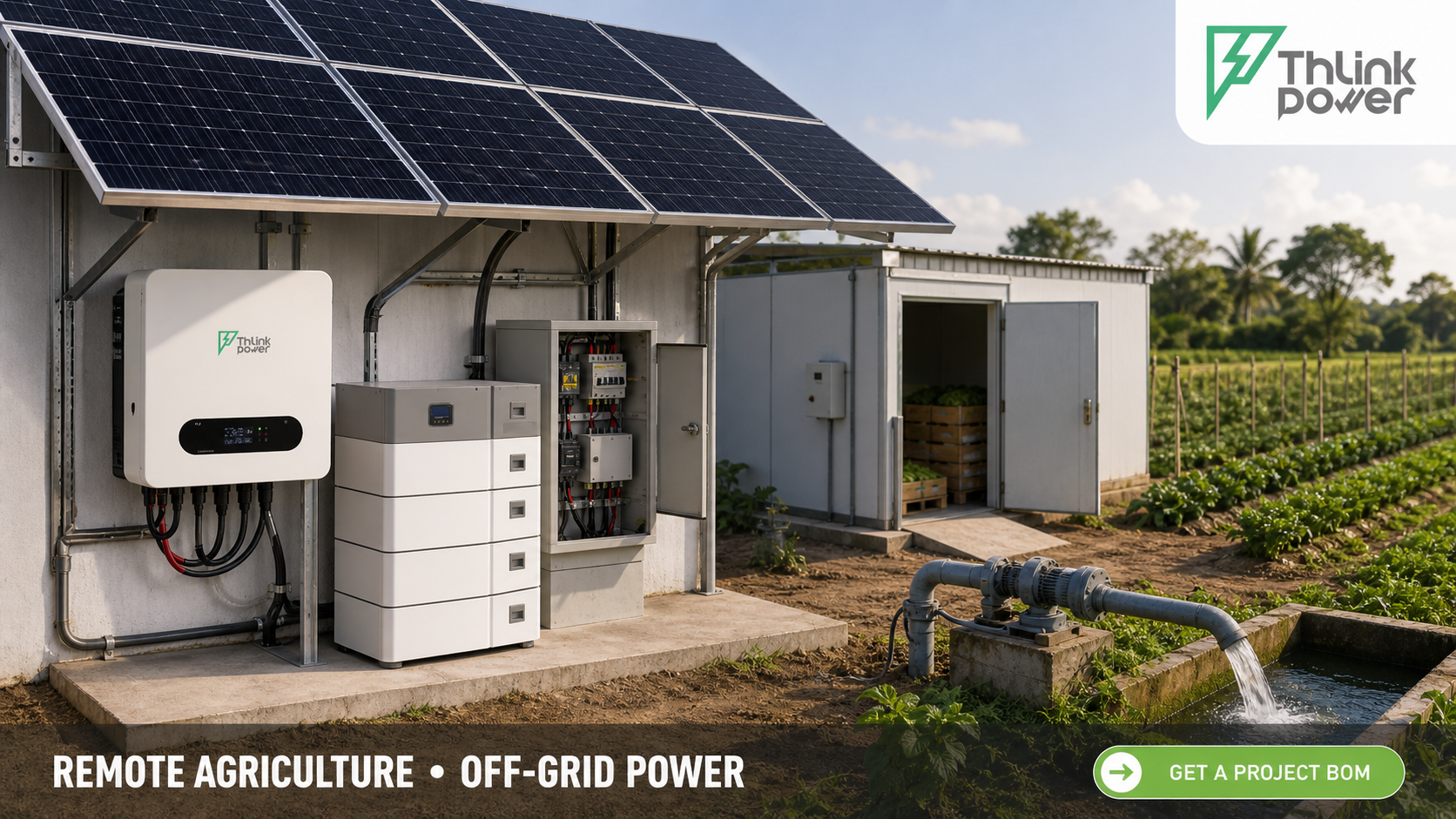
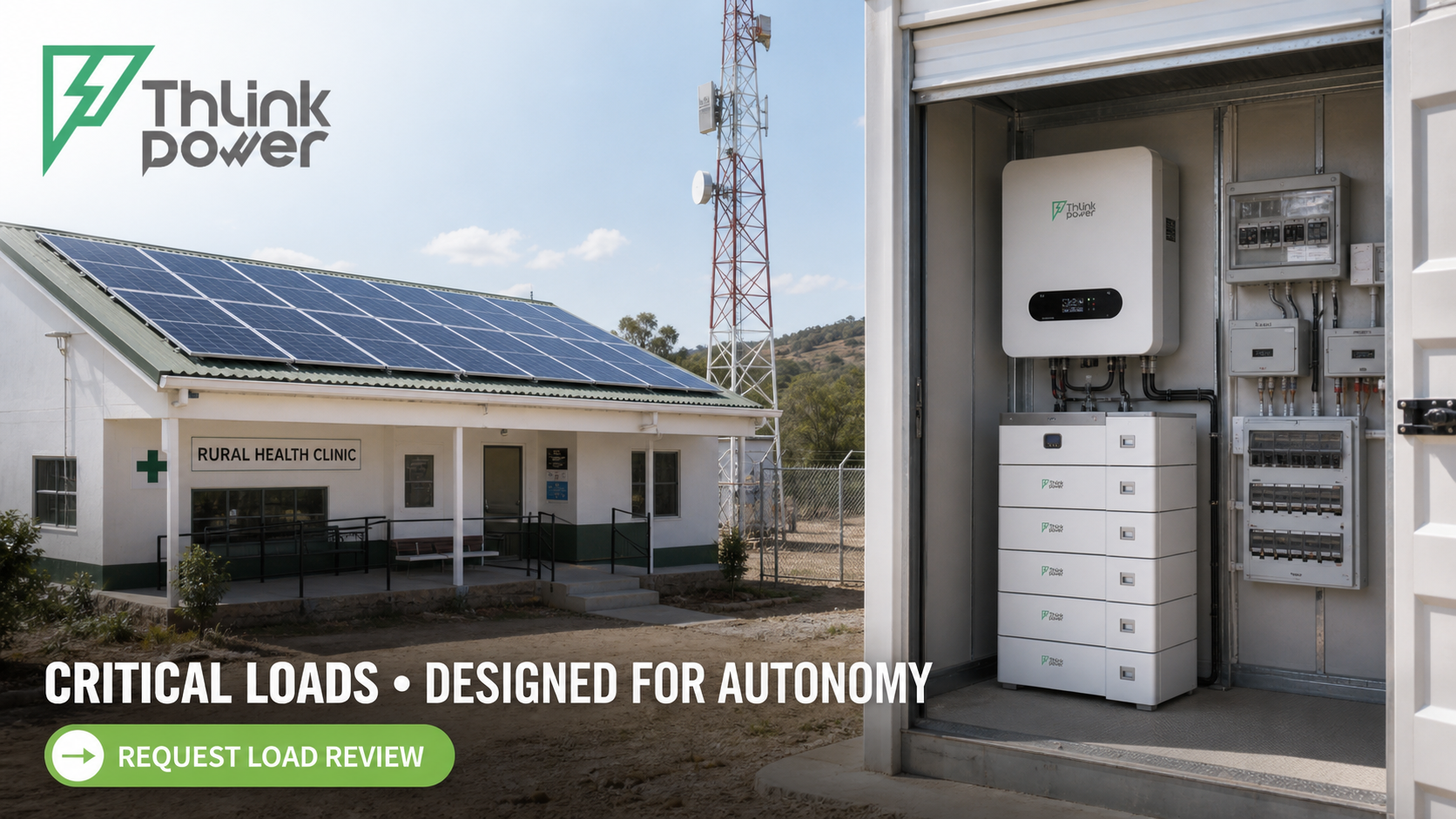
Consider a remote produce store with measured protected-load demand of 21 kWh on a demanding day.Its steady coincident load is 3.6 kW, while a compressor and pump can create a brief higher demand. The owner accepts daytime pumping and will keep a small generator for exceptional weather. This is enough to demonstrate a method, but not enough to release equipment.
First, the engineer checks the time-series load rather than multiplying a single peak by 24 hours. Next, the battery screen uses the night and protected-load energy, the allowed depth of discharge, conversion losses, reserve and temperature. The PV screen uses the weakest design month rather than annual average sunshine. The inverter screen uses continuous load, reactive power and the worst permitted starting sequence.
Suppose the energy screen suggests roughly 30 kWh nominal storage and the power screen points to an inverter above the 3.6 kW steady load. Those numbers are deliberately incomplete. The final design still needs the compressor start measurement, module string check, battery current check, solar resource, battery pairing, protection drawing and operating simulation. A good supplier will ask for those gaps instead of turning this paragraph into a fixed kit.
12.Compare architectures, not only equipment lists
| Architecture | Where it can work well | Trade-off to examine | RFQ question |
|---|---|---|---|
| PV + battery, no generator | Small, predictable loads with strong resource | More storage or accepted curtailment for rare weather | What is the design weather and loss-of-load assumption? |
| PV + battery + generator | Critical or seasonal sites with fuel access | Controls, maintenance, fuel logistics and emissions | Who supplies start logic and commissioning? |
| AC-coupled expansion | Existing AC generation or staged upgrades | Multiple conversion paths and control coordination | How is power limited during island operation? |
| DC-coupled hybrid | Integrated new systems | Compatibility and single-platform dependence | Which batteries and firmware are approved? |
| Load-managed microgrid | Pumps, heating or processing that can be shifted | Operational discipline and control design | Which loads may be shed, and in what order? |
Architecture decisions should survive a component substitution. If the buyer changes a module or battery, the engineer must revisit the affected calculations. If the design only works with one undocumented setting, record that dependency. A clear interface matrix prevents the panel vendor, battery vendor, inverter vendor and installer from each assuming another party owns the missing work.
13.Request model-specific quality and compliance evidence
Certificates are not brand-wide magic. Ask for the certificate holder, model family, suffix, standard edition, laboratory or certification body, issue date and market scope. Match the label on the proposed product. Where a national electrical approval or grid rule applies, confirm it with the authority or local consultant. Off-grid equipment may avoid a grid-interconnection requirement, but it still has electrical, product, installation, transport and building obligations.
Battery shipments require transport evidence tied to the actual battery type. UNECE's current Manual of Tests and Criteria files include subsection 38.3 for lithium cells and batteries. Ask for the test summary, MSDS and shipping classification as applicable, then let the freight forwarder confirm the route and packing. A generic screenshot saying “UN38.3 available” is not an auditable document set.
For PV array design, IEC 62548-1:2023 describes requirements for wiring, protection, switching and earthing. Product safety and qualification standards should be connected to exact models and local adoption. Standards identify a framework; they do not replace the project engineer, installation code or an applicable certificate.
14. Factory acceptance testing before dispatch
Factory acceptance testing should reflect the purchased configuration. Begin with identity: model, suffix, firmware, serials and accessories. Verify packaging and labels.For an integrated system, document communications pairing, parameter file, protection settings and the behavior of source transitions within a safe test setup. Record test instruments and pass criteria before the test starts.
- Review approved drawings, BOM revision and any substitutions.
- Match module, inverter, battery and communication accessory model codes.
- Inspect workmanship, connectors, torque records, cable identification and enclosure condition.
- Run functional startup, shutdown, alarm, monitoring and communication checks.
- Verify agreed charge limits, load priorities and generator-control logic where the test setup permits.
- Capture serial lists, photos, test sheets, firmware and final parameter backups.
- Confirm packing list, spare kit, manuals and destination labels before sealing.
A witness test is valuable only when the buyer can see the acceptance basis. Video alone may show the equipment running, but it rarely proves calibration, test conditions or configuration. Use a signed record and retain the raw measurements for critical items.
15. Site acceptance and commissioning
Receiving inspection starts before installation. Check container or crate condition, shock or tilt indicators if used, moisture, pallet stability, serials and accessory count. Photograph damage before unpacking further and follow the insurance notification timeline. For batteries, inspect the approved handling and storage instructions before energizing.
Commissioning follows the approved single-line diagram and manuals.Confirm polarity, insulation, torque, protective devices, earthing, phase, voltage and firmware. Start subsystems in the specified order. Verify PV operation, charging, load transfer, alarms, monitoring and generator logic. Then test the actual critical loads, including the agreed start sequence.
The handover pack should include as-built drawings, serials, test records, settings, firmware, manuals, warranties, spare list, maintenance plan, data ownership and support contacts. Train the operator to recognize normal states and a short list of alarms. A remote dashboard does not replace local isolation and troubleshooting competence.
16. Maintenance, spares and remote operations
Off-grid systems fail operationally as often as they fail electrically. Panels become dirty, vegetation grows, filters clog, terminals loosen, battery rooms overheat and operators bypass load priorities. Build a calendar around the site: cleaning interval, visual inspections, torque checks where permitted, ventilation, firmware governance, generator service and battery health review.
Specify a spare strategy from expected failure impact and delivery time. Fuses, connectors, fans, communication dongles, control relays and a preconfigured replacement inverter may be more valuable than a generic box of parts. For a fleet, standardization reduces training and spare inventory, but only if the chosen model is genuinely suitable across the sites.
THLinkSolar states that it can provide remote diagnosis, installation guidance, training and spare support.Put the practical service level in the order: support channel, language, time zone, evidence required for a claim, response target, advance replacement policy and who pays freight. A broad “24/7 support” statement is not a complete service process.
17. Calculate commercial cost and total cost of ownership
Unit prices do not show the cost of reliable electricity. The commercial model should include equipment, BOS, design, installation, freight, duties, finance, commissioning, fuel, scheduled replacement, maintenance, remote connectivity and expected downtime. Compare architectures over the same service requirement and study how battery life, fuel price and load growth change the result.
A commercial solar system connected to a reliable grid can be optimized around energy savings. An off-grid plant is optimized around energy service and reliability. That difference is why commercial solar system cost benchmarks cannot simply be copied into remote microgrid budgets. State the boundary of every cost-per-kWh calculation.
Ask suppliers to identify exclusions and quote basis: currency, validity, Incoterm, port, taxes, packing, spare allowance, commissioning and warranty freight. If two bids use different autonomy or battery depth-of-discharge assumptions, normalize the technical design before comparing cost.
18.Regional design questions buyers should not skip
High-temperature and dusty sites
Check inverter derating at the installation temperature, battery cooling limits, panel temperature coefficient, enclosure location, filters, dust sealing and cleaning water. A module catalog temperature rating does not define the temperature inside a battery cabinet or inverter room. We have seen a simple shade canopy solve more than an expensive model change. Air still needs a clear way out.
What changes near the coast
On a seaside drawing, I circle exposed steel, fasteners, glands and the path where condensation can collect. The enclosure's IP number answers another question; it does not tell us how a coating ages in salt. Even the spare parts need packaging that can sit in the same damp air.
Remote African and agricultural sites
Fuel logistics, technical access, mobile network coverage, theft protection, local language training and seasonal pumping can dominate the design. Prioritize simple diagnostics, protected cables and load scheduling. Do not claim country experience without an auditable project reference; use local rules and site data.
When the site is split phase
Put line-to-neutral loads in one column and line-to-line loads in another. Then check balance, neutral, the generator plate and the backup panel. A 230 V single-phase box may show the same kW on its label and still be the wrong machine for that service.
19. A procurement-ready off-grid RFQ template
- Project identity: country, coordinates, application, buyer type, target commissioning date and destination port.
- Load file: itemized table, measured profile, motor starts, critical loads, seasonal cases and expected growth.
- Service target: autonomy, acceptable interruption, load-shedding order and generator strategy.
- Electrical basis: show the service on a sketch; add measured volts, phase, frequency, earthing and the generator label.
- Environment: describe the hottest room, elevation, damp, dust, salt, flood history, wind, snow, access road and security.
- PV basis: site resource, shading, roof/ground survey, available area and preferred module constraints.
- Battery basis: name the chemistry and explain what “usable” means; attach the power, BMS, temperature and replacement notes.
- Documents: ask for the exact model's data and manual first, then list the drawings, calculations, reports and transport papers still due.
- Commercial scope: state pieces, delivery term, pack, payment and required date. Spell out warranty freight, spares, training and commissioning.
- Acceptance: sample, FAT, receiving inspection, SAT, performance monitoring and claims process.
Send the same RFQ to every shortlisted solar equipment supplier. Require a compliance column with “complies,” “deviation” or “not stated.” This produces a far more honest comparison than allowing each bidder to answer with a different brochure.
20.Questions professional buyers ask before award
Can you quote without a full load profile?
A supplier can provide a budgetary range based on clearly stated assumptions, but should not present it as a final design. Mark missing inputs and set a design-review milestone before the production order.
How many days of autonomy should we buy?
There is no universal number. It depends on the design-month solar resource, critical loads, generator availability, outage consequence, battery cost and acceptable load management. Compare reliability scenarios rather than choosing a number by habit.
Can solar panels, battery and inverter be bought separately?
Yes, but an accountable engineer must own the interfaces: string voltage/current, battery voltage/current/protocol, controls, protection, mechanical layout and commissioning. A bundled offer can simplify responsibility only when the bundle is fully documented.
What information produces a faster quotation?
Country, voltage, phase, daily load profile, motor details, autonomy target, solar site, temperature, quantity, destination port and delivery target. Photos and one-line diagrams remove ambiguity. A message containing only kW does not.
Does THLinkSolar guarantee every certification listed on the website?
Certification must be verified for the exact model and market. Request the current certificate and report set. Do not apply a brand-level statement to every product family.
21. Failure-mode review before the design is frozen
A useful review asks what happens when one assumption is wrong.If solar yield is below forecast, which load is shed first? If a battery module disconnects, can the remaining modules carry the current? If the generator fails to start, how long do critical loads remain supported? If the monitoring link is lost, can a local operator diagnose and restart the plant safely?
Write each failure beside a detection method and a controlled response. Low state of charge may trigger a warning, load shed and generator start in that order. High inverter temperature may call for derating before shutdown. A communication fault may fall back to conservative battery limits only when the product manuals and supplier approve that behavior. The logic belongs in the commissioning test and operator guide.
| Failure or deviation | Early warning | Designed response | Procurement evidence |
|---|---|---|---|
| One cloudy week exceeds the model | State-of-charge trend | Shift discretionary loads; generator support | Energy model and operating rule |
| Battery module unavailable | BMS alarm / current imbalance | Limit load or isolate affected string | Parallel architecture and fault procedure |
| PV string open circuit | MPPT current deviation | Inspect isolation/connector/string | String map and safe test procedure |
| Inverter overtemperature | Temperature / derating alarm | Reduce load; restore ventilation | Derating curve and clearance plan |
| Remote monitoring offline | Heartbeat loss | Continue local control; dispatch by priority | Local HMI and data ownership plan |
| Generator start failure | No run feedback | Manual start or deeper load shed | I/O test and operator instruction |
22. Score suppliers on engineering closure
A supplier scorecard should reward complete answers, not brochure volume. Give weight to product fit, calculation transparency, model-specific documents, interface ownership, inspection access, delivery realism and claim support. Separate “not stated” from “noncompliant.” A supplier that identifies an information gap may be safer than one that says yes to everything.
For an initial shortlist, procurement can score technical compliance, evidence, commercial basis, project support and lifecycle service. Do not let a single weighted total hide a fatal gap. Wrong phase, insufficient surge, absent battery pairing or a missing required approval should remain a stop condition regardless of price.
- Technical closure: load basis, architecture, PV strings, battery power/energy, protection and climate.
- Evidence closure: exact-model datasheets, manuals, certificate scope, test records and label identity.
- Delivery closure: BOM revision, production lead time, packing, dangerous-goods route and destination documents.
- Commissioning closure: drawings, settings, FAT/SAT, training, remote access and as-built handover.
- Service closure: triage process, spare strategy, warranty remedy, freight responsibility and escalation.
23. Data package for future expansion
Remote sites often grow. Preserve half-hour or finer load and generation data when practical, battery state-of-charge history, generator run hours, curtailment and alarms. After one operating season, compare measured demand and solar yield with the design assumptions. This turns the next expansion from a guess into an engineering decision.
Expansion needs space, electrical capacity and control planning. A second battery string may require different protection and communication addresses. More PV may exceed MPPT current or voltage. Parallel inverters require supported synchronization and shared-load behavior.Reserve provisions only when they are documented; an empty breaker position is not proof that the system can expand.
24. Leave the operator one folder that actually works
A week after handover, somebody should be able to find the final drawing without searching a message thread. Our folder starts with the as-built one-line, array plan and string map. Behind those come structure, cables and protection, followed by serials, firmware, saved settings, test sheets, manuals, warranties, spare inventory and the phone tree.
Add an assumptions register. It should show design load, solar data, autonomy definition, battery usable-energy basis, generator policy, temperature and growth allowance. When a future operator changes a setting or adds equipment, the register explains what could be affected. This is especially important where the original EPC team cannot visit quickly.
25. Questions to settle in the design-review meeting
Use the meeting to close decisions, not to reread brochures. The buyer should bring the latest load file, site survey and commercial constraints. The electrical engineer should own phase, voltage, strings, protection and earthing. The storage specialist should own usable-energy and current assumptions. The supplier should identify exact models, deviations and evidence still pending.
- Which load profile and seasonal case is the design based on, and who approved it?
- What event sets inverter power: steady demand, motor start or simultaneous contingency?
- How is autonomy defined, and what reserve remains at the end of that period?
- Which weather month and loss assumptions set PV capacity?
- What starts the generator, what stops it, and what happens if the start fails?
- Which model-specific documents must arrive before deposit, FAT and shipment?
- Which settings are locked, who may change them and how is the change logged?
- What is the claims path if a component, configuration or packing issue is found?
End the meeting with an action register containing owner and date. Open points should remain open in the quotation rather than disappearing into an optimistic assumption. This discipline speeds the final order because technical and commercial teams are working from the same revision.
26. Where THLinkSolar can support the procurement process
THLinkSolar positions itself as a Ningbo-based supplier of inverters, modules, lithium storage and complete systems, with OEM/ODM, selection, remote installation guidance, training and after-sales support. For a serious B2B inquiry, the useful next step is not a generic catalog request. Send the technical brief so sales and engineering can identify a model set, information gaps and documents to verify.
The wider system still touches every procurement pillar. Buyers may need a solar panels wholesale packing plan, a matched inverter, a documented battery, structural coordination and a solar system design review. Keeping those interfaces under one RFQ reduces gaps and creates a clearer responsibility matrix.
What to attach to the first inquiry
Attach the load spreadsheet, one-line diagram if available, nameplate photographs, a week of interval data, site coordinates, roof or ground images, generator label, target autonomy, temperature range, destination port and required delivery date. Mark estimates clearly. This compact evidence pack lets engineering spend time on the design instead of repeatedly asking for basic facts.
If information is unavailable, say so. The supplier can issue a budget concept with an assumptions register and a list of measurements needed for final design. Honest uncertainty is safer and usually faster than inventing precision.
Request Off-Grid System Sizing, a Preliminary BOM and a B2B Quote
Sources and scope: the product ranges came from THLinkSolar's inverter and module catalogues plus the stackable-battery page reviewed for this article. IEC 62548-1:2023 is used only to point readers toward array-design scope. For battery shipping, the reference is UNECE's Manual of Tests and Criteria. None of those sources fixes a project quote. Design, approvals, warranty, stock, price and delivery still belong to the exact model and destination.
This guide is a procurement framework, not a stamped electrical design. Final calculations, protective-device selection, structural design, installation and commissioning must be completed or approved by qualified professionals under the applicable local rules.